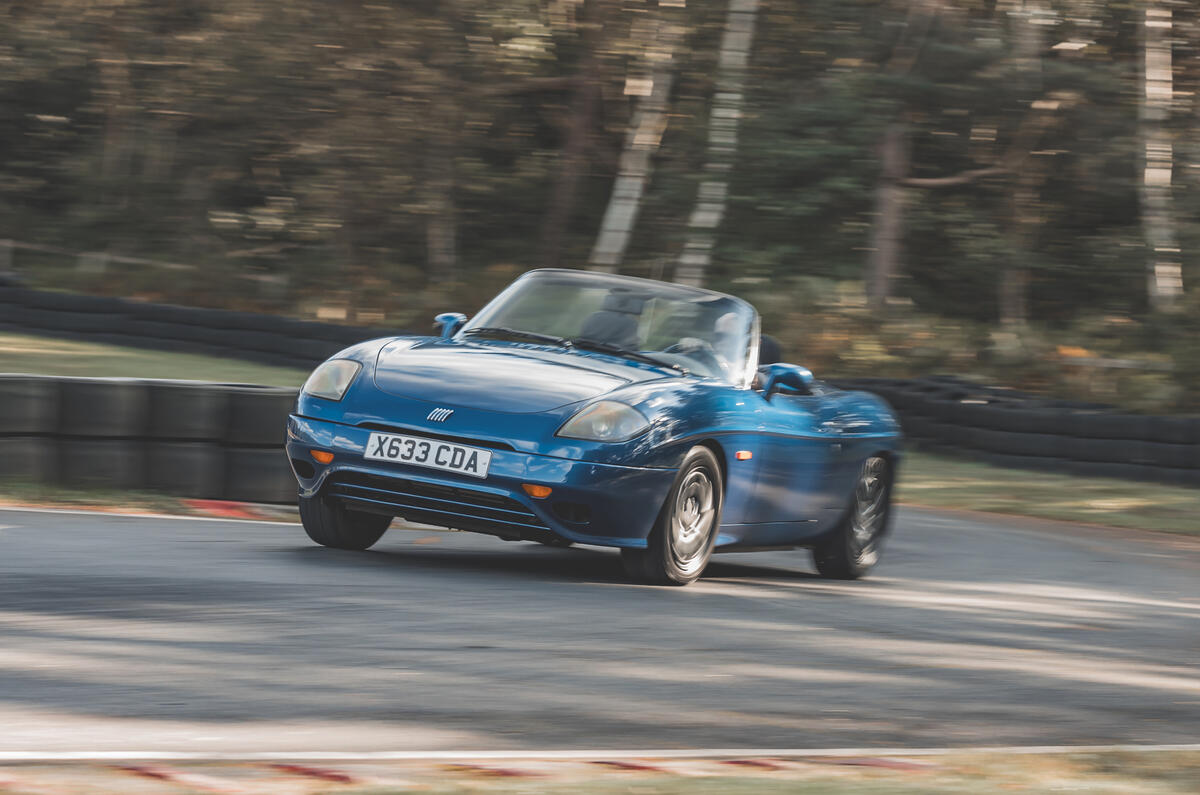

Now, these are cheap. I’ve just found a 50,000-miler for £5000, and you can shave at least a grand off if you don’t mind doubling that mileage.
One major reason for the cheapness, apart from age, is that the Barchetta was offered only with left-hand drive – although specialists DTR turned six examples into right-hookers.
Another is the curious brand image of Fiat, which is desirable, colourful and fun if you have in mind the 500 but a bit of a bargain basement if it’s pretty much everything else.
The Barchetta tends towards the less palatable end of this spectrum, despite being pretty, Italian and a sports car, partly because of Fiat’s reputation from more distant eras in which rust, unreliability and poor quality generated sometimes well-founded suspicion.
In the Barchetta’s case, it will pay to maintain some of that suspicion, because they do rust, despite the use of galvanized steel.
These cars were hand-built by coachbuilder Maggiora, the result sometimes a less-than-charmingly artisanal approach to spot welding and wax injection. So while a Barchetta’s underseal might look intact, some of it could have the tensile resistance of a pre-dinner savoury snack.
The Barchetta is reliable, though. The only common weakness is the camshaft timing variator, and the repair of this rattling efficiency enhancer isn’t too expensive.
The reliability stems largely from the fact that the Barchetta was built on the platform of the Tipo 176 (original, that is) Fiat Punto, with the apparent downside of this hardware source – a sizeable dynamic shortfall – not realised in practice.
Despite being front-wheel-drive and riding on relatively unsophisticated suspension, the Barchetta serves up surprisingly entertaining handling, mixing good grip with decent front-end bite and the poise to encourage you to use it to the full.
There’s more good news from under the bonnet, as the 1.7-litre 16-valve twin-cam engine fizzes with an enthusiasm encouragingly echoed by a rorty exhaust. Its 129bhp wasn’t a bad output for the day and is all the more effective because there’s only 1056kg to pull along.
All of this provides high entertainment on the dreamed-of winding, sun-drenched road, best of all with the roof down. Dropping the fabric top requires the faff of exiting the car to open and close the rear deck, but the resulting look is particularly tidy.
Looks are a big part of the Barchetta’s appeal, the crease pressed into its flanks resembling the wake of the small boat that inspired its name. The voluptuous billow of its wings, the flush tail-lights and the enclosed (rather dim) headlights all heighten its allure.
The need to keep the price low produced an interior of relatively minimal kit, but you still got electric windows, an appealingly sculpted dashboard, very ‘90s white instrument faces and the contrast (unless your Barchetta was black-on-black) provided by body-coloured sections of the dashboard and doors. Fiat also provided moulded rubber floor mats that were undeniably practical in an open car.
Your choice will be limited as there are few survivors. But the hunt will be worth it, especially if you find one of the limited-edition models with pleated leather upholstery and a colour-coordinated roof.