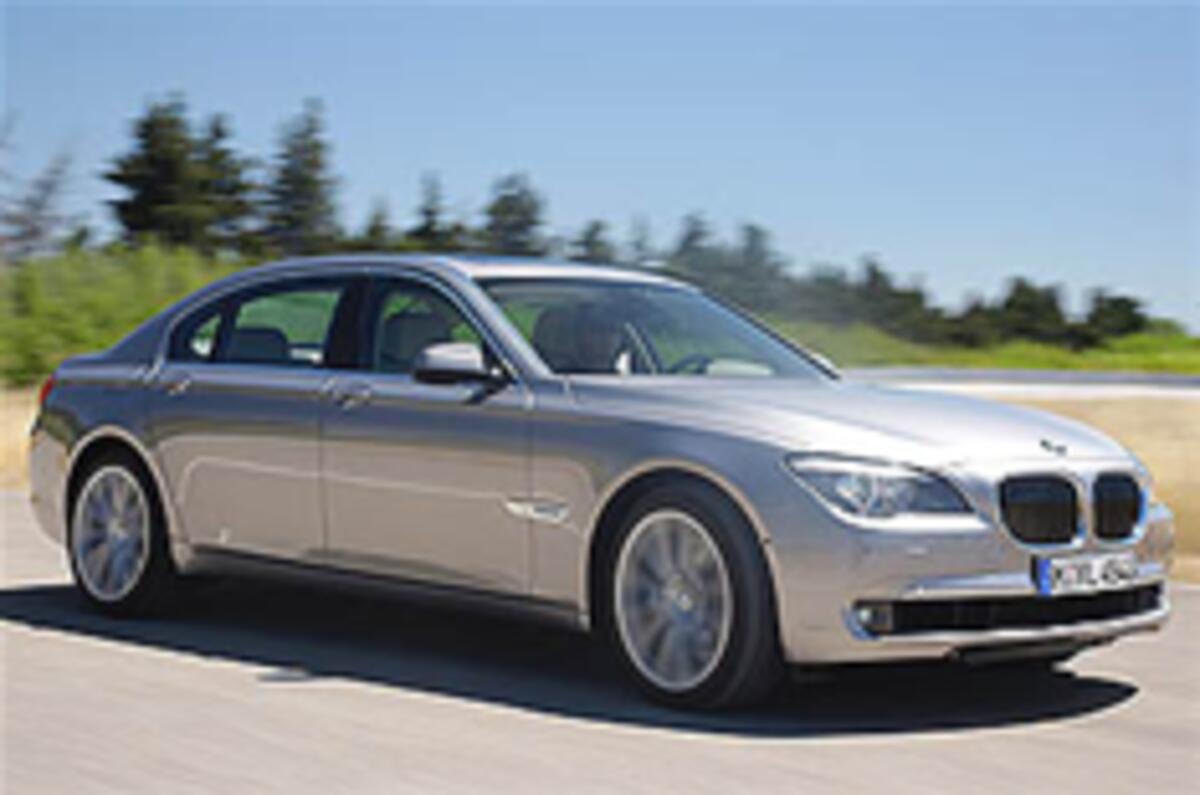

BMW has revealed a unique set of innovations for its forthcoming 7-series – both in its cabin and chassis – which it believes will make its new flagship the best equipped luxury car on sale in Europe.
We’ve already seen the external design, but now BMW has released full details of what lies beneath the 7’s svelte surface detailing, too.
The new car introduces a new active chassis management system (branded as IMS) similar in principle to Land Rover’s Terrain Respose. This groups a variety of variable settings for the chassis, transmission and engine into four driver-chosen settings: Comfort, Normal, Sport and Sport Plus.
It’s a similar principle to that already offered by various rival manufacturers. Each setting varies damper settings, steering weight, the gearchange map, throttle response and the intervention threshold of the stability control. ‘Comfort’ gives the new 7-series its best-ever refinement, says BMW, while ‘Sport’ reportedly makes it ‘handle like a 3-Series.’
>> See more pics of the new BMW 7-series
New for the 7-Series, BMW’s familiar active steering system has been combined with a new rear-steering system. Below 35 mph the rear wheels turn in the opposite direction to the front wheels to reduce the turning circle and increase low-speed agility. At higher speeds they turn in the same direction as the front wheels (up to three degrees) to stabilise fast cornering or lane-changing manoeuvres.
Other refinements in the all-new fifth-generation 7-Series include several eco refinements, including a weight-saving programme that has cut mass by 55kg compared to the outgoing model, despite the new car’s extra equipment and an aerodynamic flap in the radiator grille that blanks off unnecessary airflow to reduce drag.
The car will also boast a huge amount of new smart technology. The camera/navigation system reads road signs and displays the current speed limit on the dash, a comprehensive head-up display, a night-vision system with thermal imaging built in that can ‘see’ people and animals out of normal sight, a collision warning system, and a lane-departure warning system that vibrates the steering wheel and displays a dashboard message if there’s a car in your blind spot. BMW claims that no other car in the class has such a comprehensive array of safety and convenience gadgets.
There are three engine options, all mated to the latest, power-saving ZF six-speed auto. The big seller will be the 730d, powered by a turbocharged version of BMW’s 3.0-litre six cylinder diesel engine, producting 242bhp at 4000rpm plus 399lb ft between 1750 and 3000 rpm. Though it has 10 percent more torque than the old 3.0 litre, fuel consumoption is down 10 percent, and CO2 output is just 192 gm/km. The diesel accelerates from 0-62mph in 7.2 seconds and can do 150 mph.
Despite the promise of its boot-badge, the 740i is dropping the current car’s V8 power for BMW’s twin-turbo petrol 3.0-litre, good for 323bhp at 5800rpm and 332lb ft from 1500-4500rpm. And at the top of the range a twin-turbo 4.4-litre petrol V8 replaces the outgoing car’s normally aspirated 6.0 litre V12. It makes 404bhp and 443lb ft of torque, delivering a 5.2 second 0-62mph time, with top speed governed at 155 mph.
BMW won’t talk about proposed sales volumes, which is probably wise as the whole large luxury saloon egment has been suffering in recent years. The car will be in British showrooms by November in both short and long wheelbase versions, with prices sticking ‘closely’ to present levels.