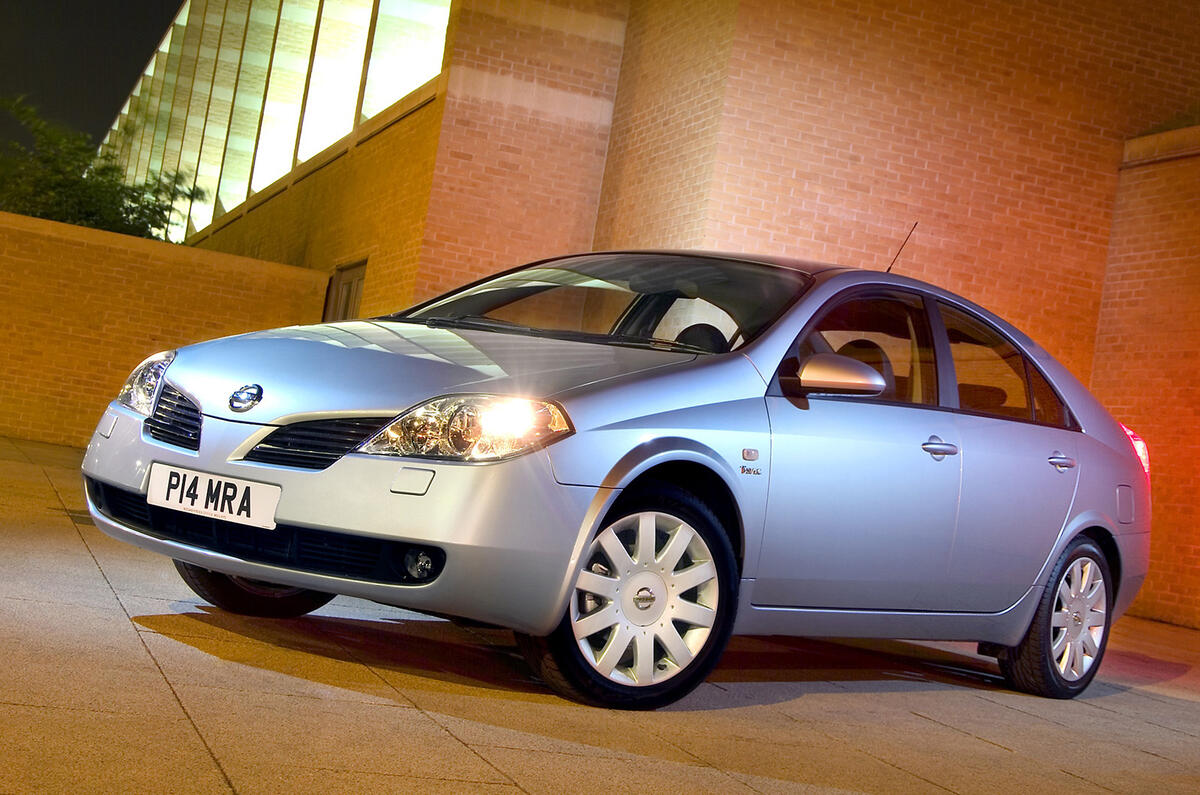
Nissan’s last Primera was a symbol of a company losing its way.
Although it emerged after Nissan’s rescue by Renault and the triggering of new boss Carlos Ghosn’s masterful turnaround plan, its bones were formed before its maker’s near-extinction and recovery.
The last generation Primera was the third iteration of a model specifically designed to appeal to European tastes. But by the time it was launched in 2001, we pesky Euros were aiming our buying power elsewhere, mainly in Germany’s direction.
This was the era of what motor industry marketing types described as “the flight to premium”, buyers fast discovering the delights of BMW, Mercedes and Audi, whose cars were (usually) better made, decidedly more prestigious and perversely, cost less on a lease because they depreciated more slowly.
All of which meant that mainstream manufacturers had to fight harder to tempt customers into a sale. Most cars in the excitingly labeled “D” segment in which the Primera played were mostly sold into fleets, whose managers allowed their colleagues far more choice than in the days when they were issued with a Ford Cortina, like it or not.
For user-choosers, as those offered a selection of company cars became known, the Primera would have been an increasingly hard sell against a car with a double kidney grille.
The original 1990 Primera did reasonably well – certainly better than the potato-stodge Bluebird that it replaced – with its shapelier style and a remarkably good chassis. Nissan ripped off a couple of BMW design cues, including the Hofmeister kink curved rear side window and badge-flanking twin grilles, while for the second-gen Primera, BMW’s design policy of consistent, incremental change was also followed.
The result was to turn the blandly European style of the 1990 P10 original into the slightly tidier Euro-bland look of the 1996 P11 follow-up. A P11 facelift in 1999 introduced Nissan’s “flying wing” twin grilles, these still more redolent of a BMW. Like the P10 the P11 handled well, its way with corners underlined by British Touring Car championship wins in 1998 and 1999.
Laurel-festooned exploits on the track were not enough to tempt would-be BMW buyers however, and for the third P12 Primera Nissan abandoned its BMW-ish design strategy and aimed for the bold.
The design programme was led by the photogenic Stephane Schwarz, who even starred in a TV ad for the car too. His aim was to apply a coupe silhouette to a family car without sabotaging its space and flexibility. While the earlier Primeras had been offered as saloon, hatchback and estate, this one came only as a hatch or a wagon. Its sizeable tailgate revealed a boot big enough for a spot of flatpack hell, the cabin large enough for backbenchers to lounge and wonder at the Primera’s spacecraft dashboard architecture.
A Primera pilot now faced the same featureless grained plastic moulding as the passenger, topped with the graceful arc of a binnacle housing centrally arrayed instruments.
Beneath these were a big screen, and below that a near horizontal deck of knobs and buttons, also arranged in an arc. Back in 2001 this was novel, as was the Nissan’s provision of kit. The aim was to tempt those premium brand flirts not only with fresh design but plenty of high-tech equipment too.

Join the debate
Add your comment
Just a minor correction; there was a 4 door version of the P12 at launch, with the hatchback version only arriving in the first year of production due to engineering delays.