From £35,48510

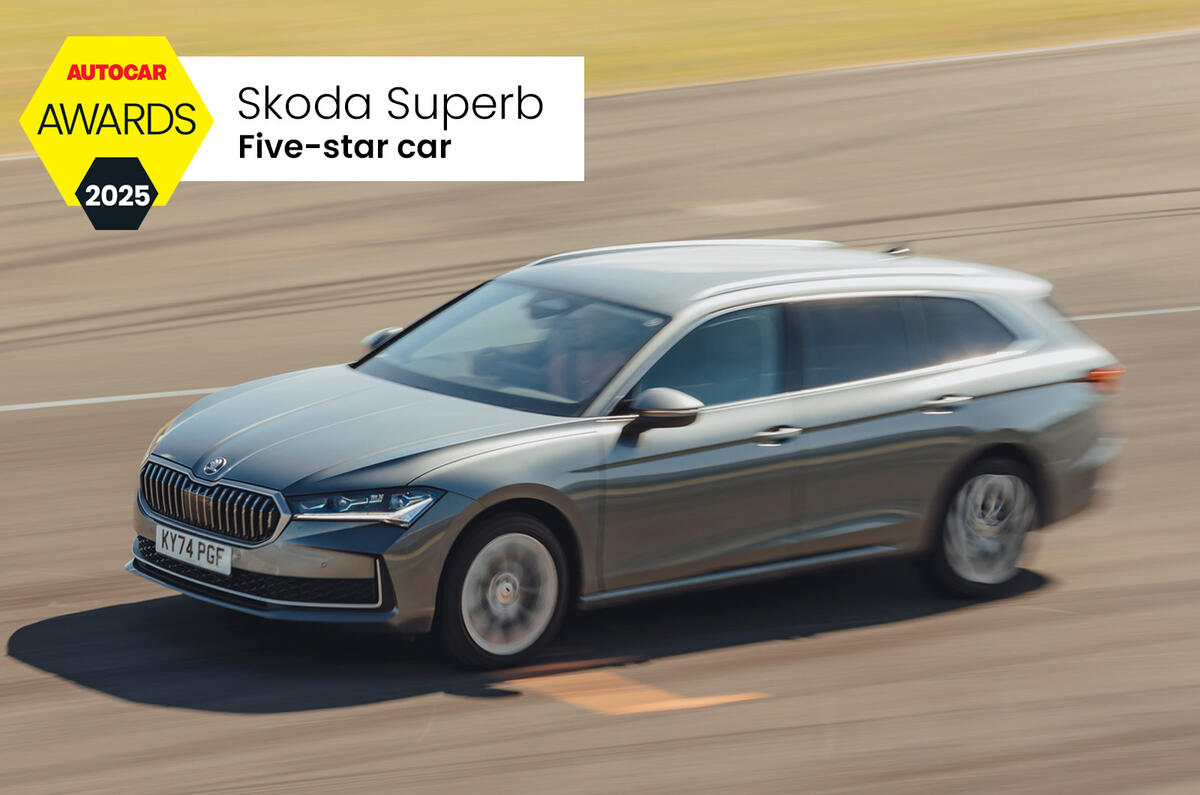
Skoda keeps its powertrain options open with its big, traditional saloon-cum-estate flagship

Skoda has gone up in the world - and within the Volkswagen Group. Where the Skoda Superb started as a stretched Volkswagen Passat, evolving to a stretched Passat with a weird boot, and finally to nearly the Passat’s equal in the outgoing generation, the latest, fourth-generation Superb has turned the tables.

The new Superb and Volkswagen Passat were developed side by side, but with the process led by Skoda. The Mladá Boleslav firm has turned from follower to leader, not just taking an important role in the development of new cars but also tearing off the shared-platform straitjacket, such as by introducing off-menu user-interface concepts that increase usability through common sense.

At the same time, the Superb has fewer traditional big saloon rivals than ever. The premium German brands persist with their executive saloons and estates, but comparable cars from Vauxhall, Ford and the Japanese brands are long gone. Instead, the Superb’s biggest challenge will be to convince buyers not to choose the ubiquitous SUV and instead go for the classic estate.

The range at a glance

Models Power From
1.5 TSI e-TEC SE Technology 148bhp £36,795
2.0 TDI SE Technology 148bhp £37,290
2.0 TSI SE L 201bhp £42,045
1.5 TSI iV SE Technology (estate only) 201bhp £41,575
2.0 TDI 4x4 SE L 190bhp £44,460
2.0 TSI 4x4 SPORTLINE 261bhp £48,650

Skoda still offers a quite extensive engine and derivative range for the Superb in the UK. There are currently three petrol options, two diesels and a plug-in hybrid to choose from; although the iV PHEV can only be had if you go for an estate body, and the VW Group's higher-output 'eHybrid' powertrain isn't offered at all. 

Advertisement
Back to top

The most powerful petrol and diesel models have four-wheel drive. There are four trim levels: SE Technology, SE L, Sportline and Laurin & Klement, although not all engines can be combined with every trim level. All Superbs get a dual-clutch automatic gearbox.

DESIGN & STYLING

10
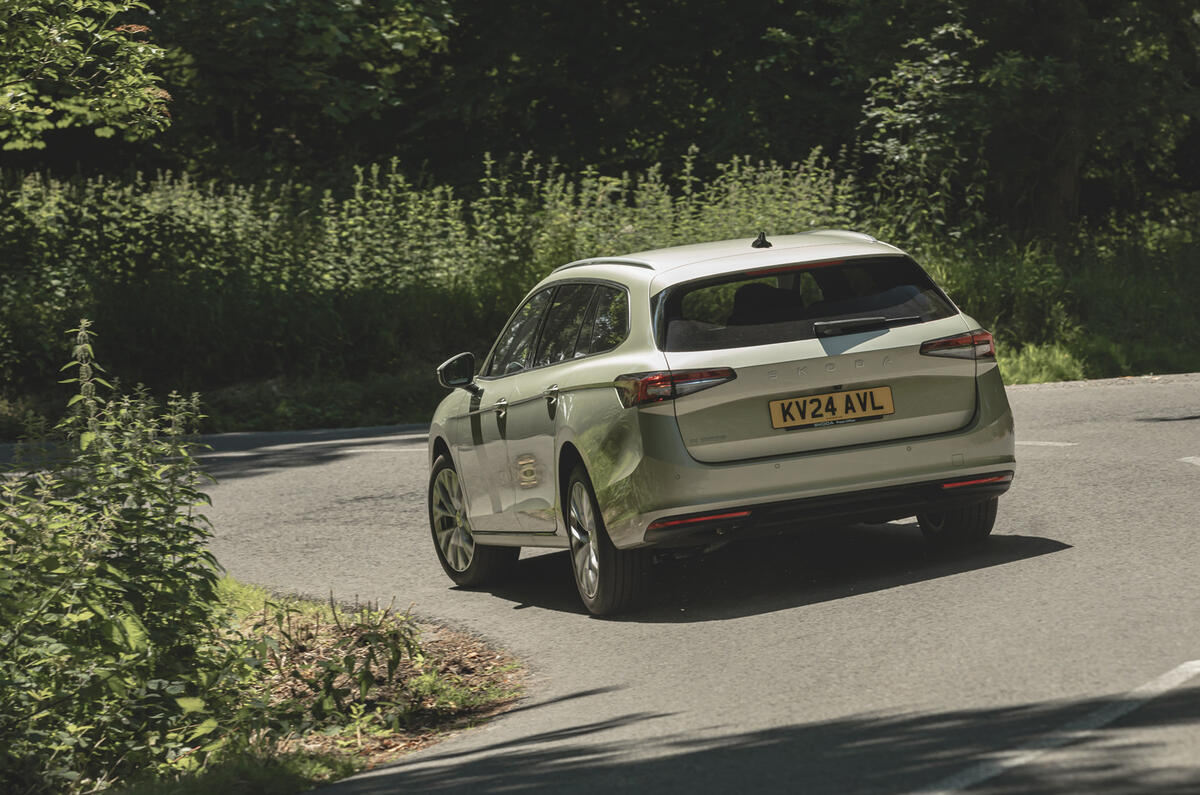
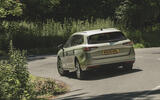
2 Skoda Superb 2024 rear corner

Skoda has had no small amount of success with SUVs itself, particularly with this new Superb's sibling model, the Skoda Kodiaq. Along with the new Volkswagen Passat and Tiguan, both Skodas are among a group of new cars developed more or less simultaneously on the latest 'Evo' version of the Volkswagen Group’s MQB platform.

The big leaps forward come by way of a completely revamped multimedia system (of which more later) and drastically increased capacity for the plug-in hybrid version's drive battery pack. This goes from just 13kWh in the old Superb iV to 25.7kWh in the new one, giving it serious company car credentials. Fleet users be aware, though; you can only have an 'iV' plug-in hybrid powertrain in tandem with an estate body, and Superb estates come at a premium of around £1400 over saloons (which, strictly speaking, remain big hatchbacks anyway).

The other powertrains are updates of well-known four-cylinder petrols and diesels. Somewhat surprisingly, only the entry-level 1.5-litre petrol gains mild-hybrid assistance. Manual gearboxes are out for this generation: every Superb gets a DSG dual-clutch automatic, with six forward gears in the PHEV and seven- elsewhere.

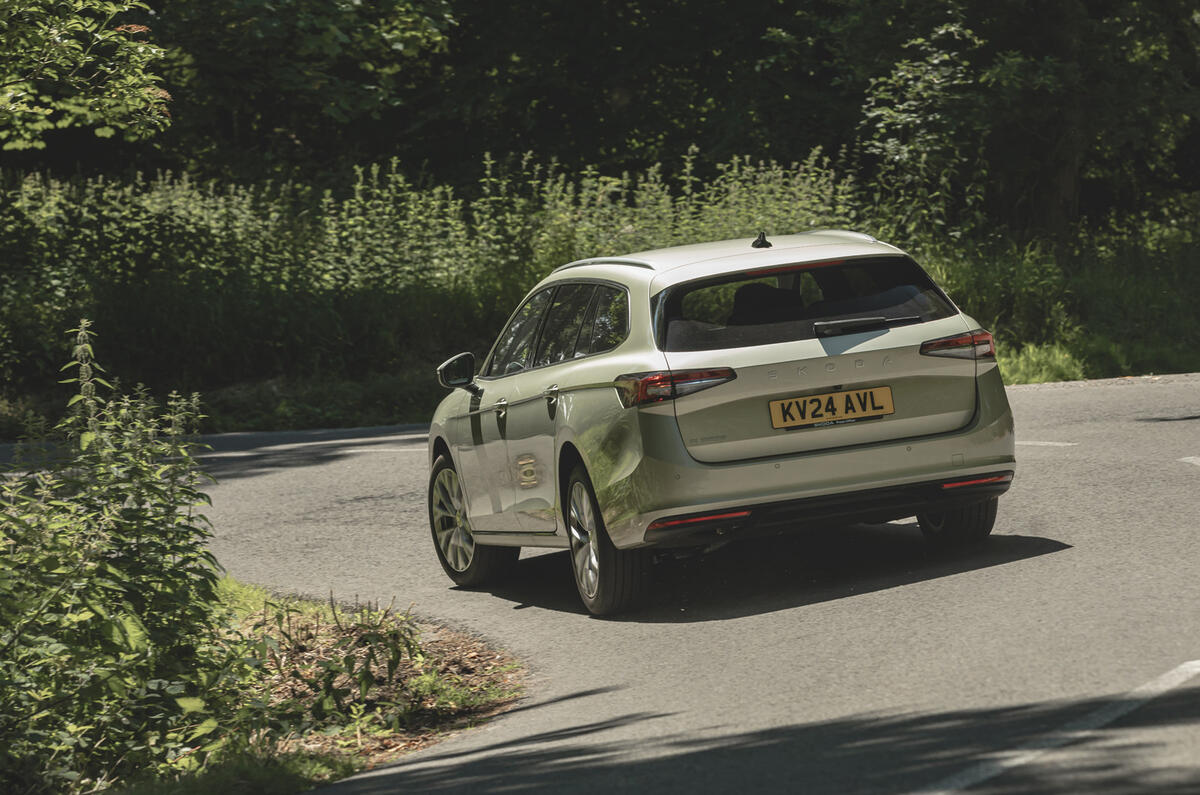
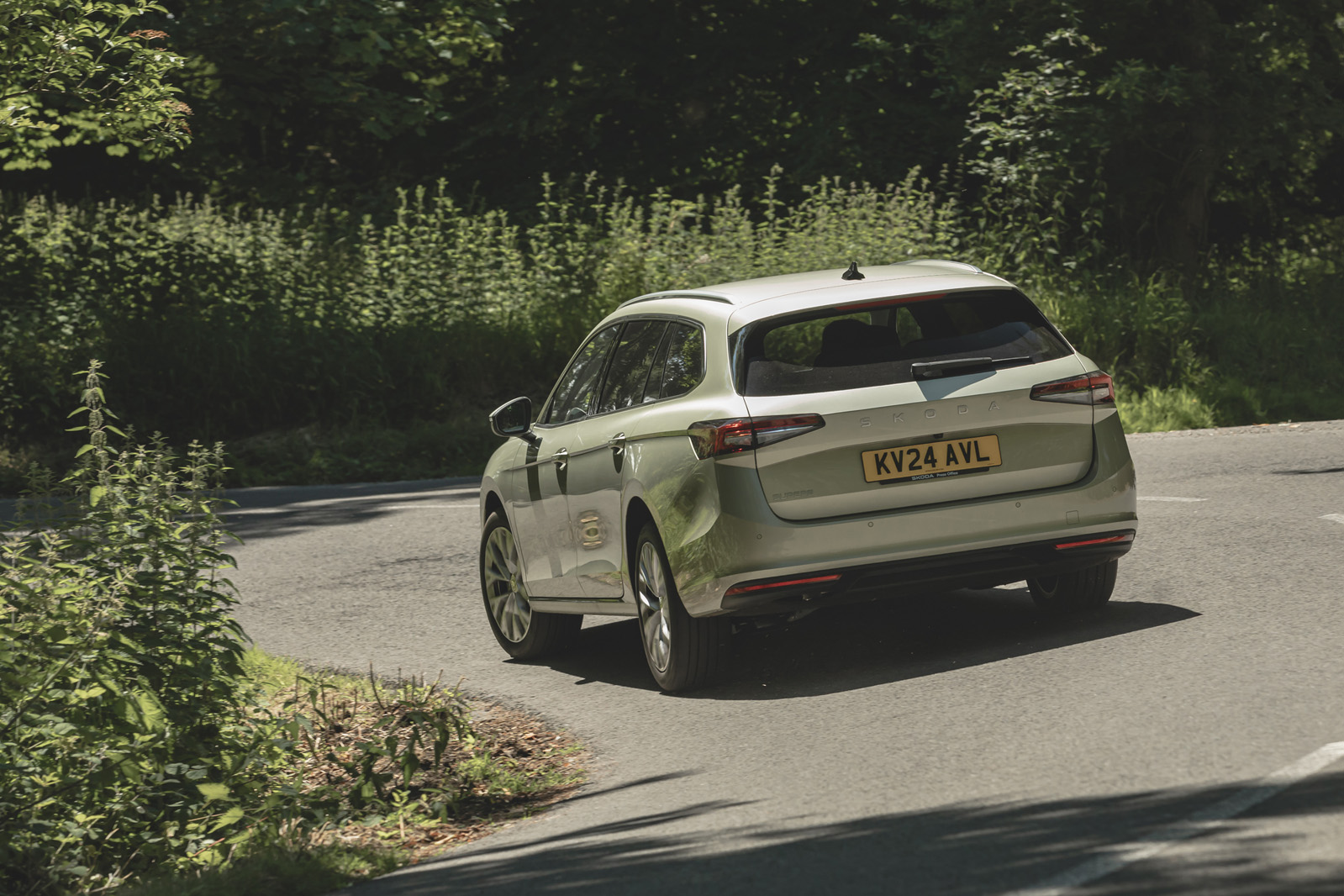
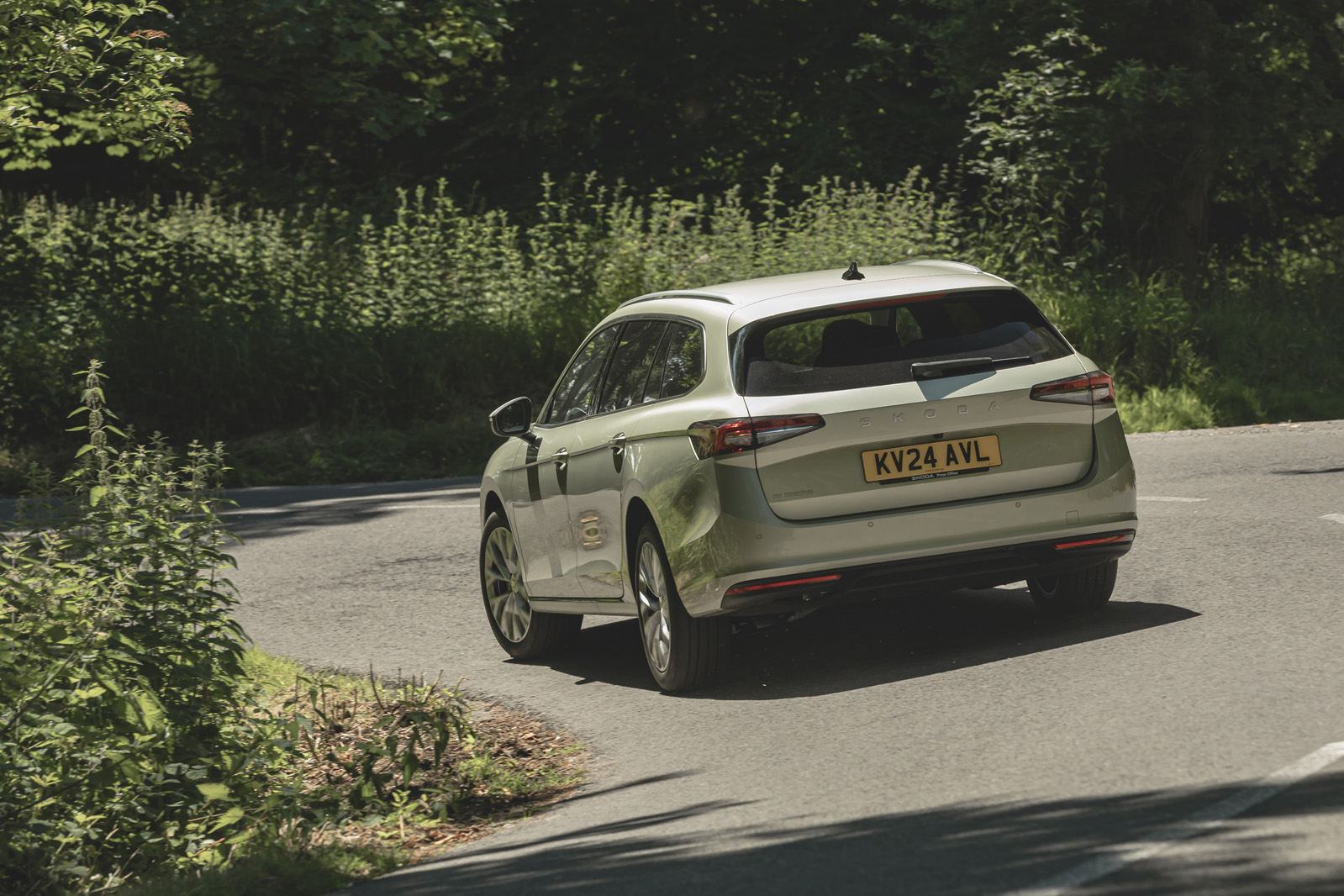
As is usually the case with a new model generation, the Superb has grown considerably. It has done so more judiciously than most, however. The fourth-generation car is 4.9m long – 40mm longer than its predecessor. That’s all in the overhangs, since the wheelbase remains at 2841mm. It’s slightly taller too; but, to the delight of anyone who regularly negotiates tight city streets or hedge-lined country lanes, also 15mm narrower across the body.

The same reduction didn’t show in our measurement across the mirrors (2090mm versus 2035mm), but any slowdown in the bloat of new cars is a positive development in our book.

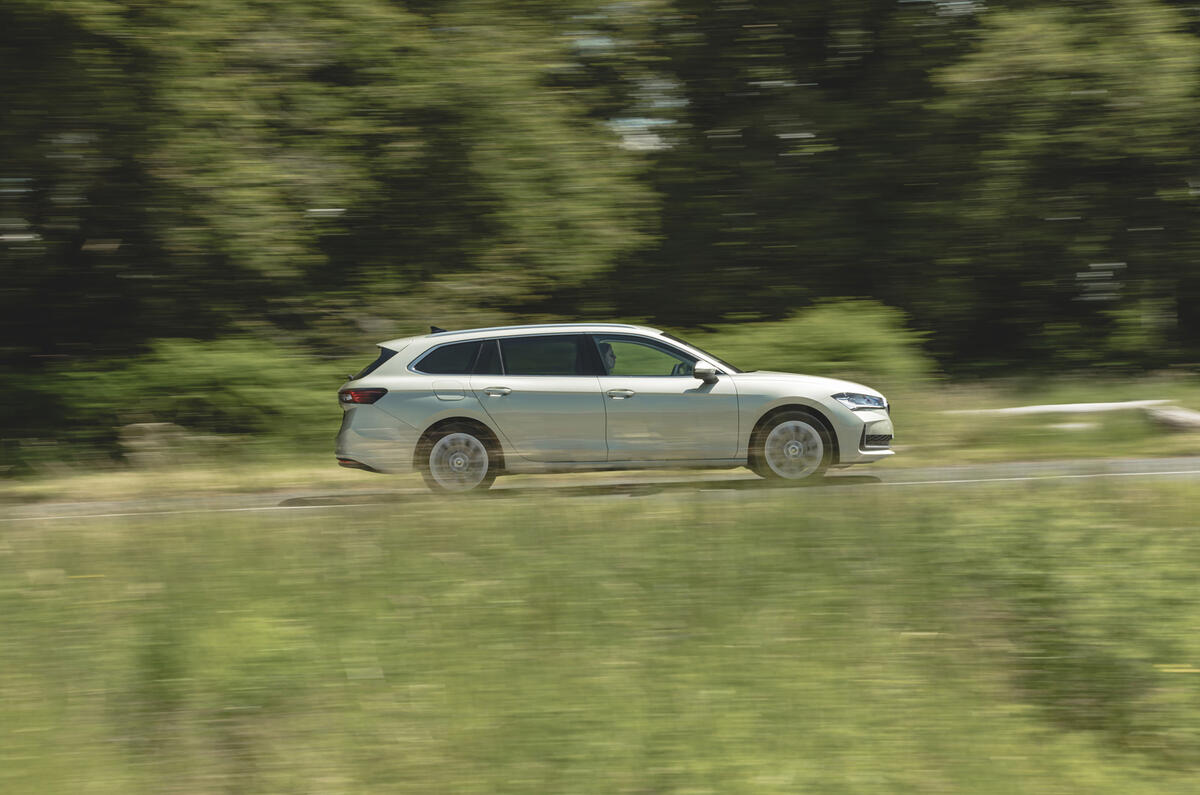
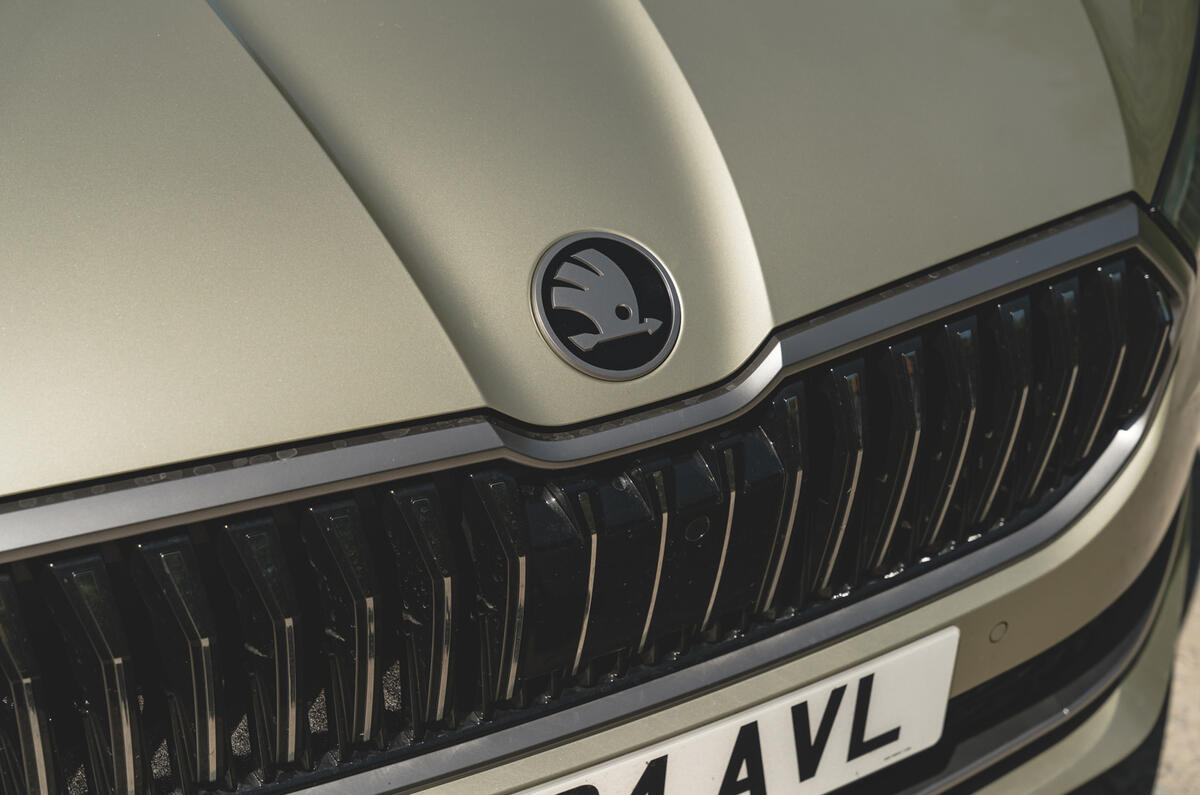
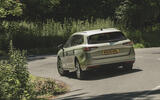
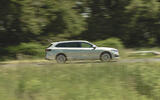
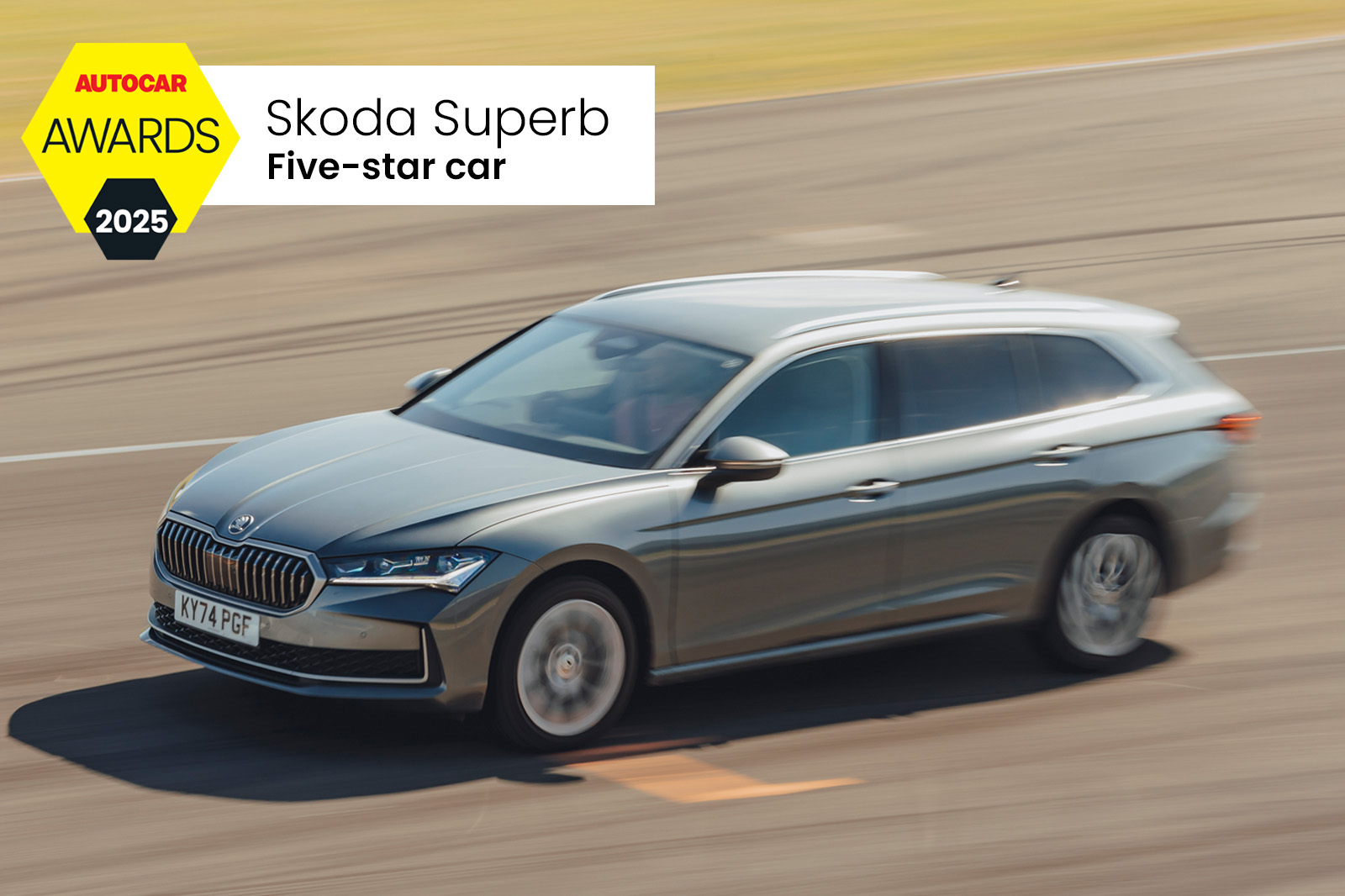
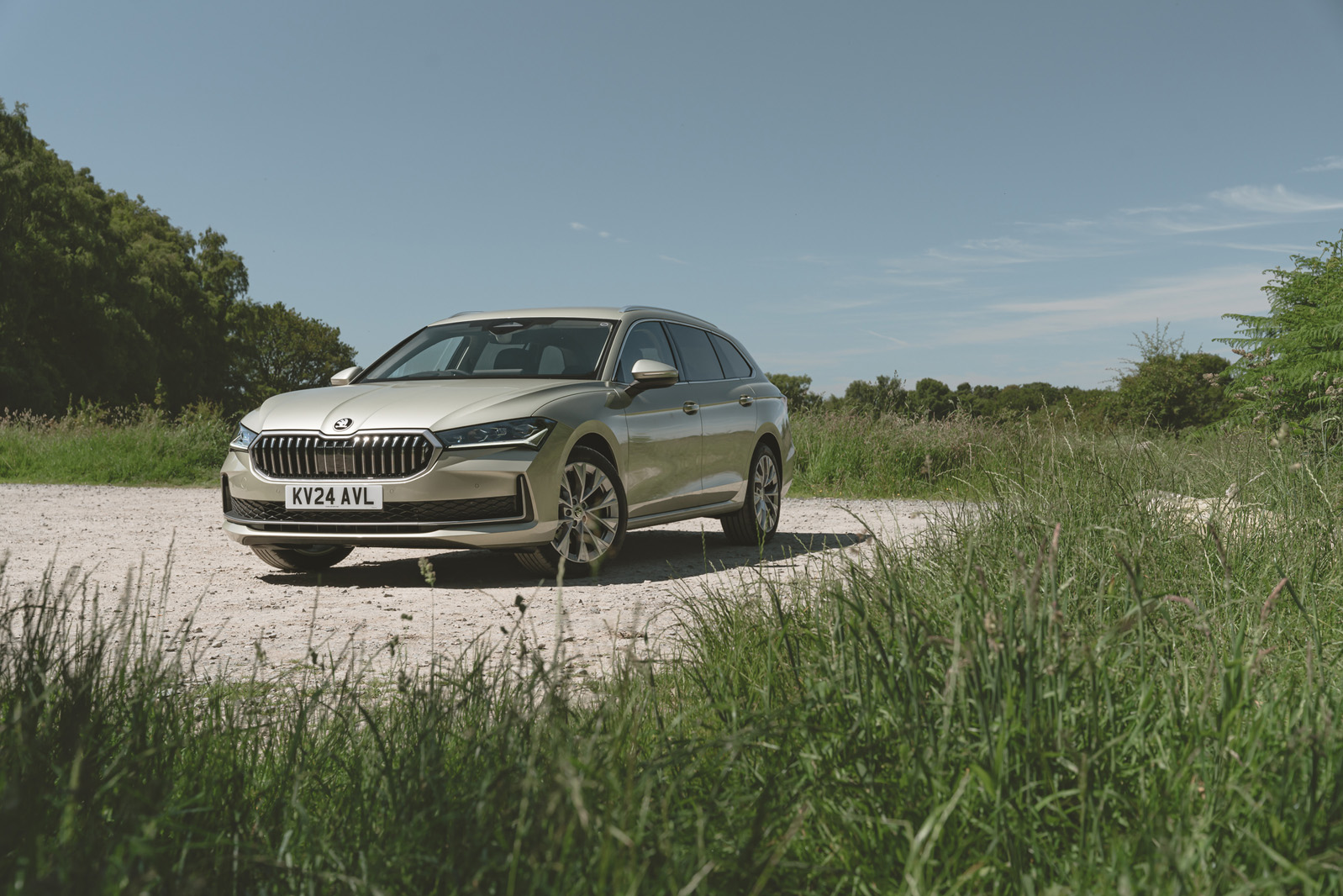
Design-wise, the Superb seems to staunchly reject styling fads. There’s no light bar, no light-up grille, and no black wheels; and only the Sportline version comes with even the most understated performance-flavoured bodykit. There’s even some subtle chrome trim around the grille and the window surrounds. It’s more rounded than the old car, but follows the Enyaq EV’s design language rather than the fussier style of the Kodiaq.

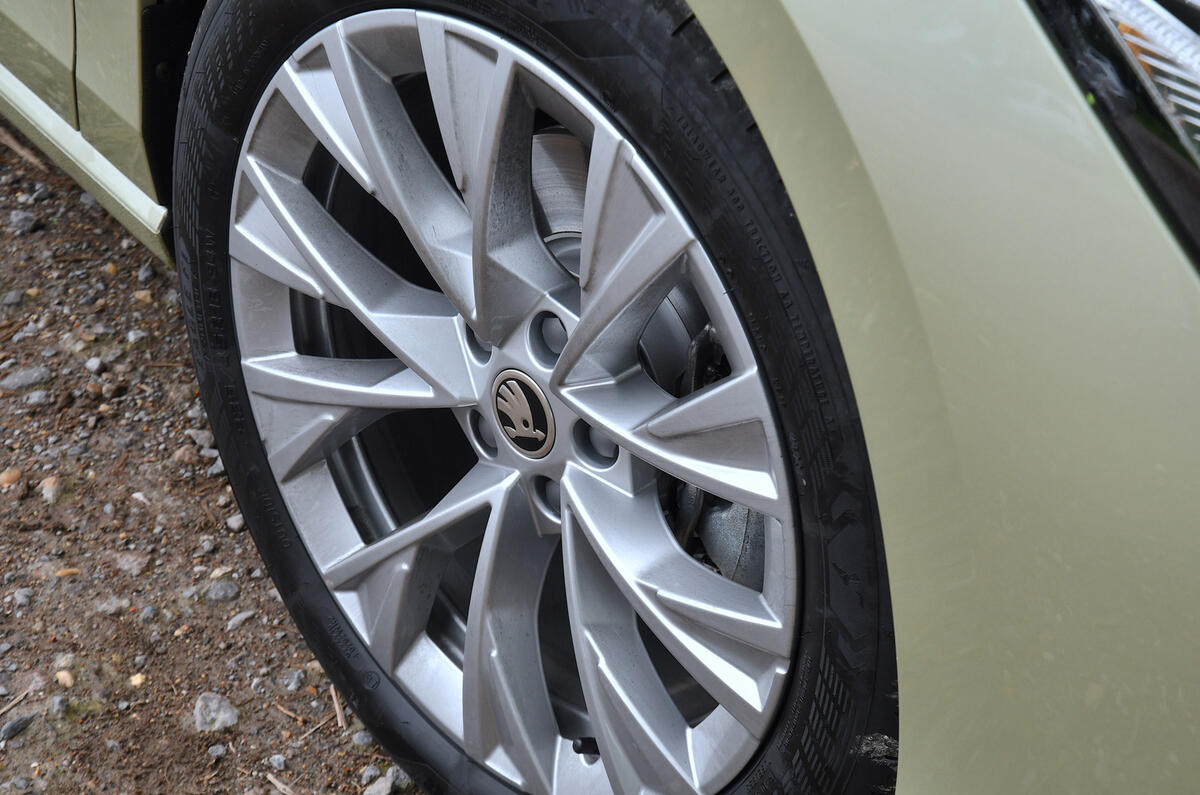
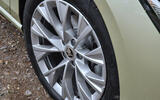
How your Superb looks will be determined by which trim you go for. Little separates SE Technology and SE L aesthetically, but Sportline is certainly the most aggressive, if not the most distinctive of the Superb line-up. Diamond-cut 19in wheels, more angular bumpers and gloss black trim give the Sportline a more assertive look compared with its rangemates, while the L&K maintains its luxury undertones with its chrome exterior elements. 

The Superb’s low-slung body also gave the engineers the opportunity to go to town on the aerodynamics. While it was never going to be as slippery as an electric saloon (which needs far fewer openings to provide cooling), a flatter windscreen, a more streamlined roofline, a roof spoiler with side fins, redesigned exterior mirrors and active shutters for the grille have brought the drag coefficient down to 0.25 for the most aerodynamic versions of the estate. As before, the Superb remains available as a five-door liftback as well; and on some versions of that model, the drag coefficient is as low as 0.23.

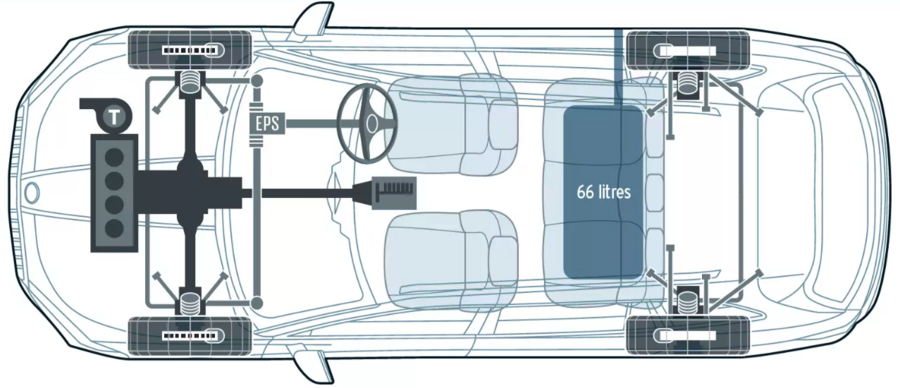
The core suspension layout is conventional, with MacPherson struts at the front and a multi-link axle at the rear. This generation of MQB introduces the option of what the firm calls DCC (Dynamic Chassis Control) Plus suspension, which has adaptive dampers with separate valves for compression and rebound, which allows for a greater breadth of adjustment. On the Superb it comes bundled with a 'progressive dynamic' (read, variable ratio) power steering system, and is standard-fit on Sportline and L&K models or optionally available on SE L models.

INTERIOR

10
7 Skoda Superb 2024 cabin

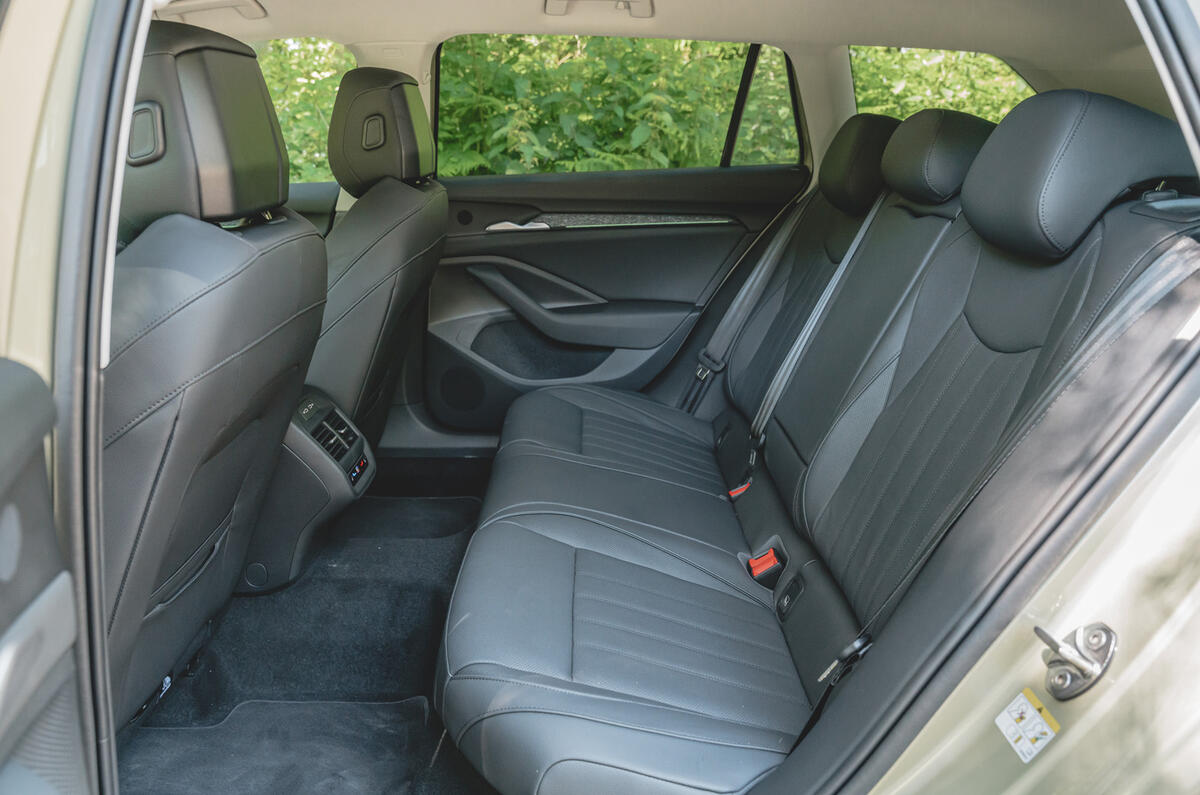
If there’s one thing you want a Skoda Superb to be, it’s roomy. Rest assured, this one is exactly that. By our measurements, typical rear leg room has increased by 65mm over the outgoing model – already a very spacious car.

Headroom is generous in both rows, too, while large side windows make for a real sense of space, as well as outstanding visibility.

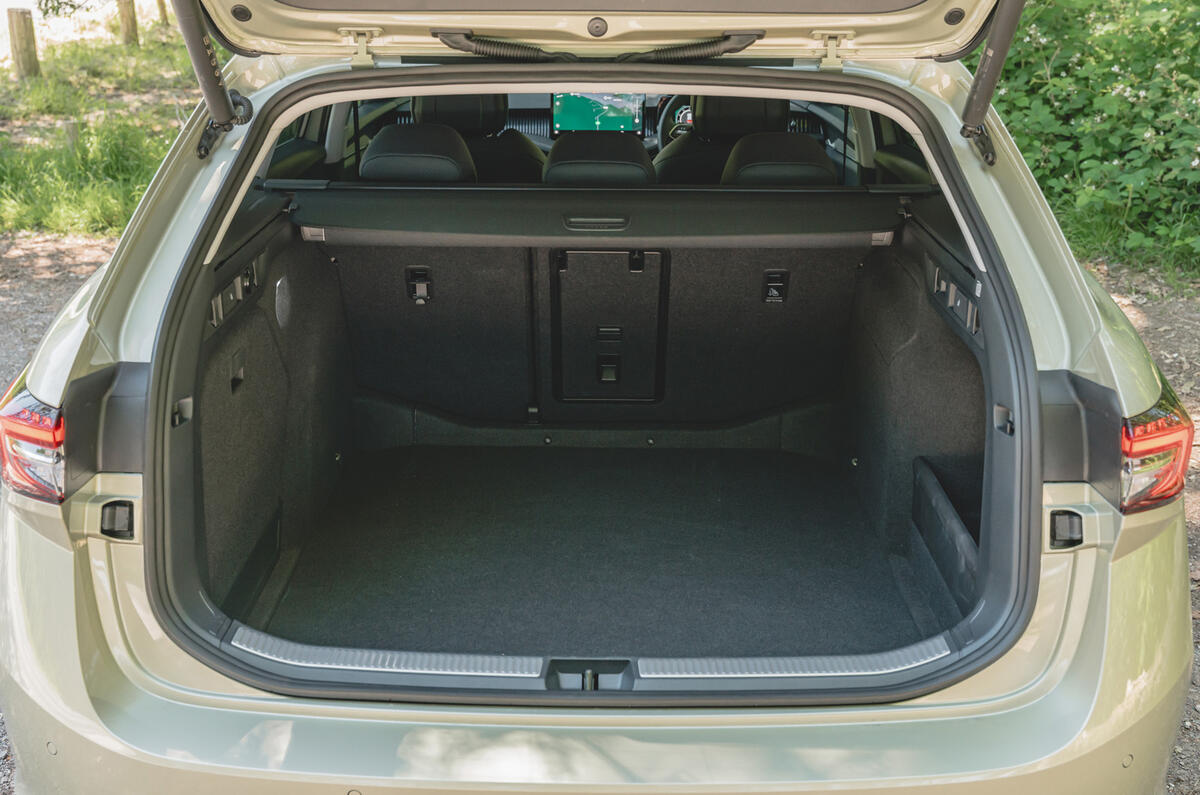
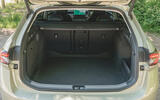
Boot dimensions have remained more or less constant, which is to say very big. As befits a Skoda, the boot has plenty of pop-out hooks and bins, and there are two levers to fold the rear seats down. Annoyingly, they don’t fold perfectly flat unless you spec the £295 variable boot floor. There’s more space under the floor, enough for a spacesaver spare wheel, which is a £185 option.

In the iV hybrid version, boot space is cut down from 690 litres under the roller cover to 510-; which sounds like a huge sacrifice. But in practice, it's only a higher loadbay floor that you have to put up with, which is at least level and even and ends up running almost flush with the folded rear seatbacks so as not to cause problems when loading longer items. You lose most of the under-floor storage of other derivatives too, as well as any loadbay floor height configurability. Even so, it's not the most unpalatable practicality compromise, and plenty of usable, accessible cargo space is left.

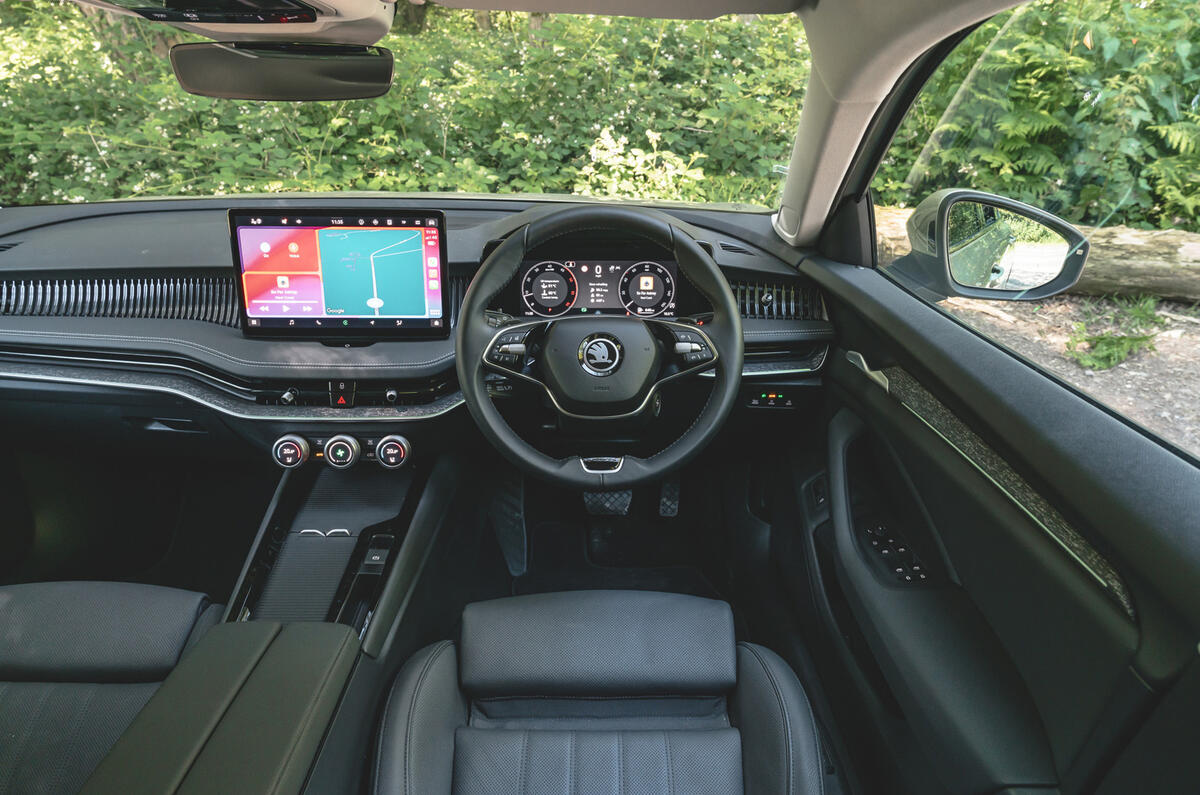
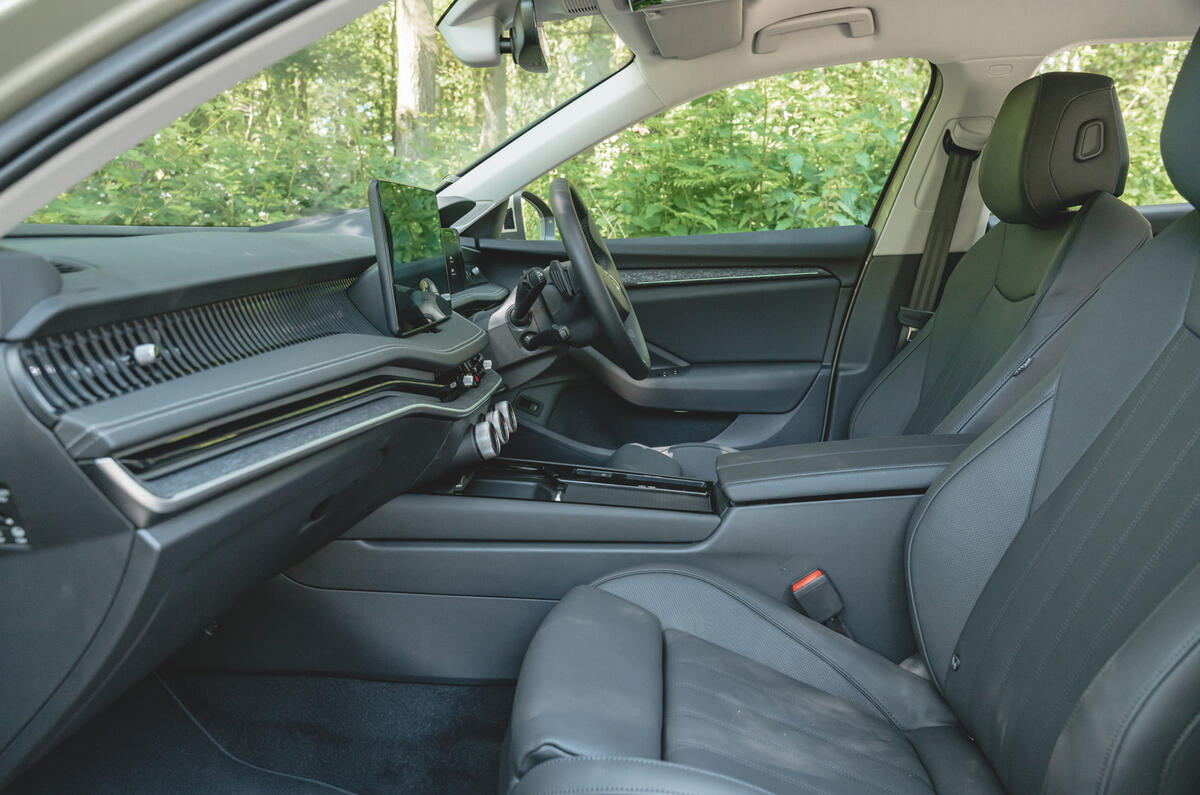
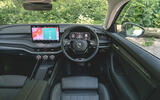
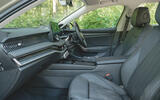
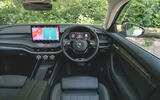
The fact that a Skoda estate is very practical won’t surprise anybody, of course. What’s arguably more impressive is what a soothing place the front cabin of the Superb is. The outgoing car already compared favourably with rivals in terms of interior material quality, even if the design was a tad plain. The new one balances classic values with modern technology like few other cars.

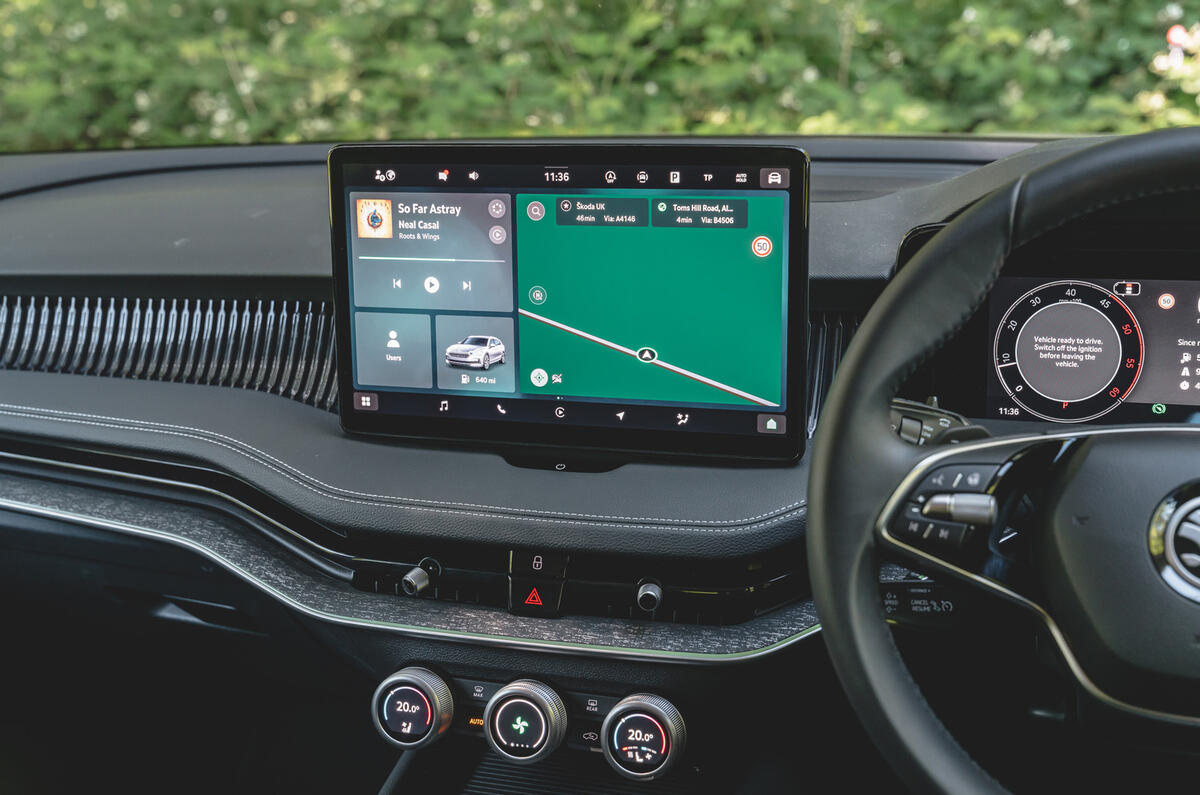
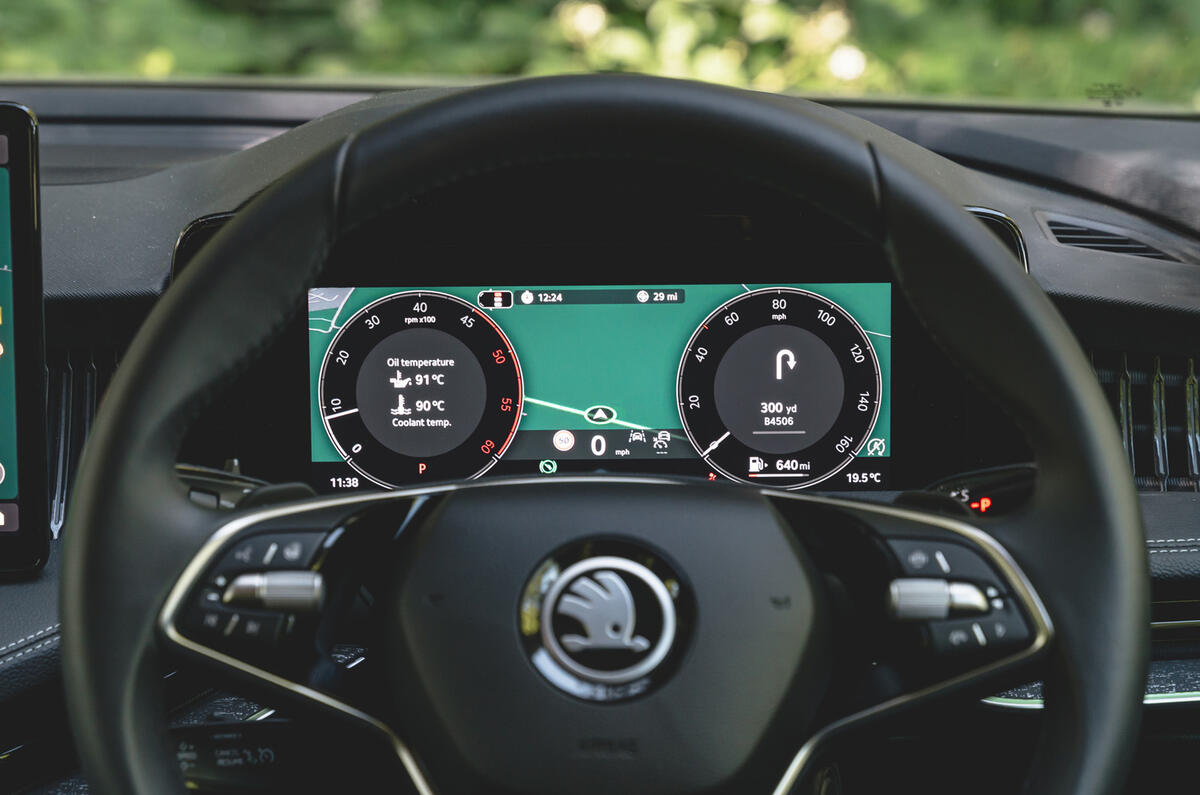
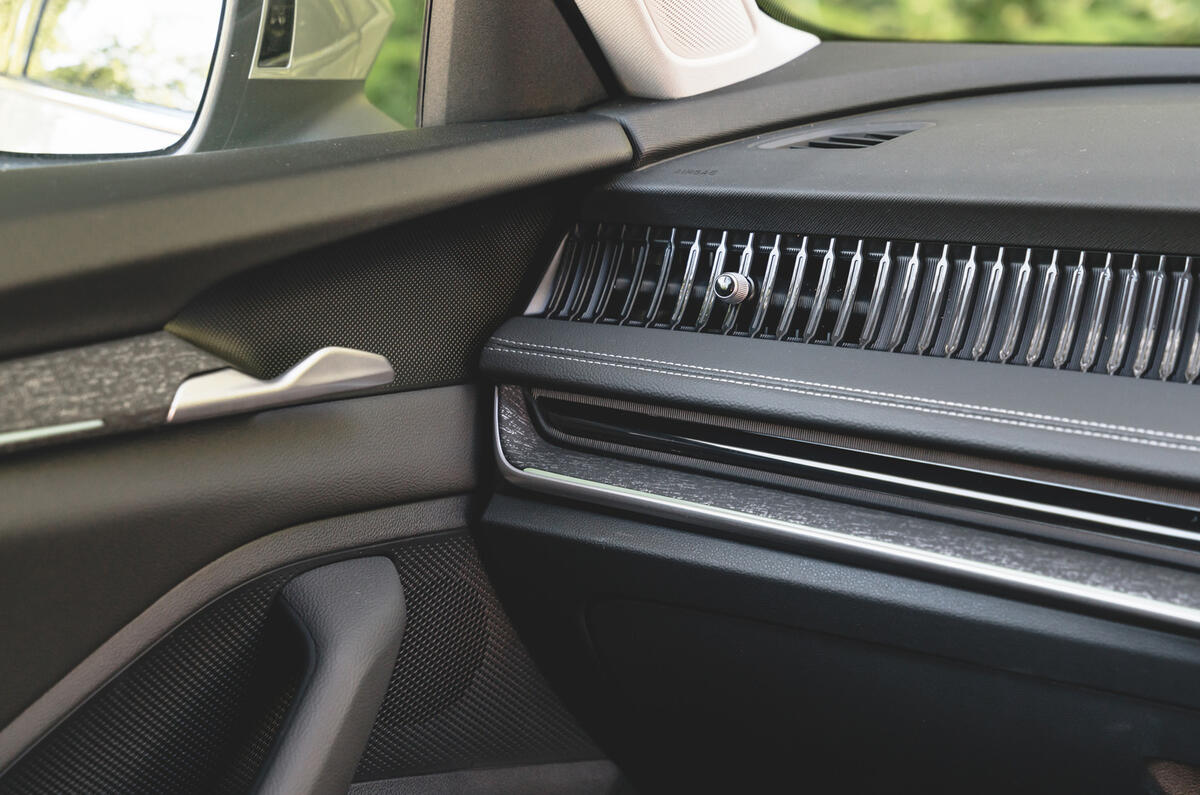
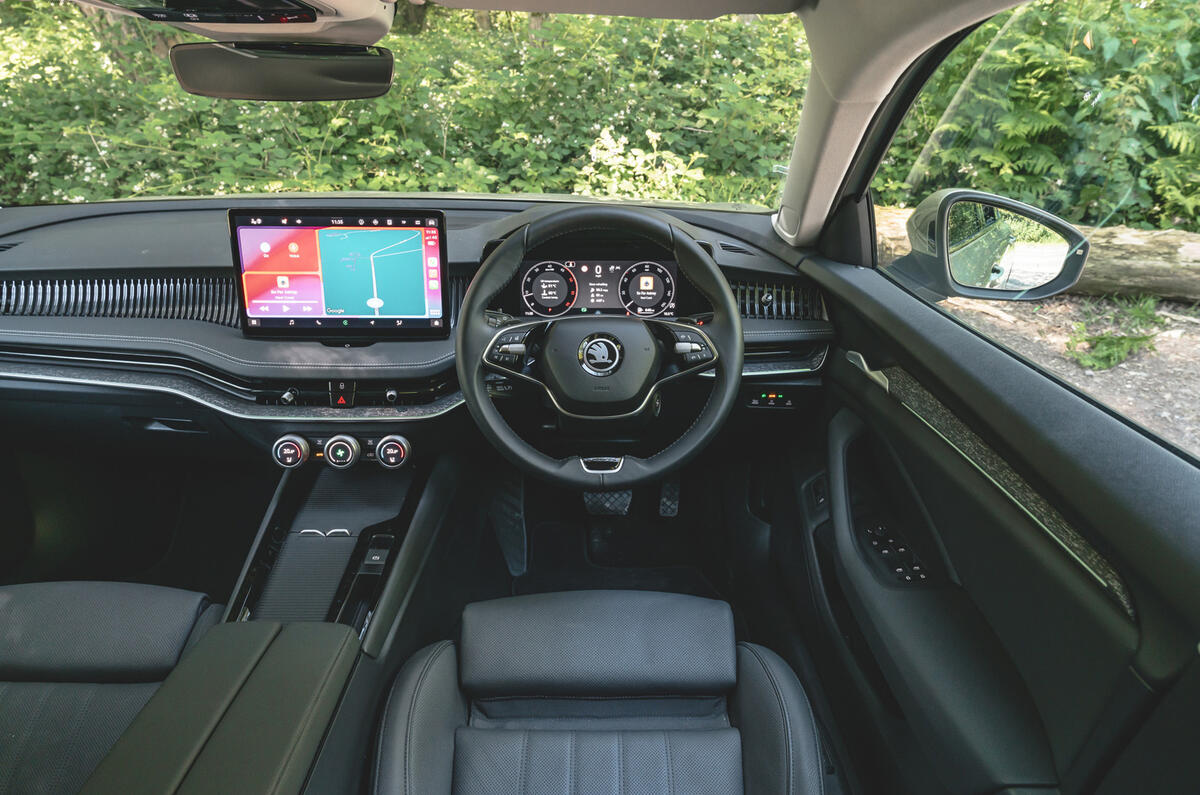
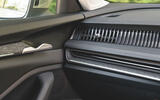
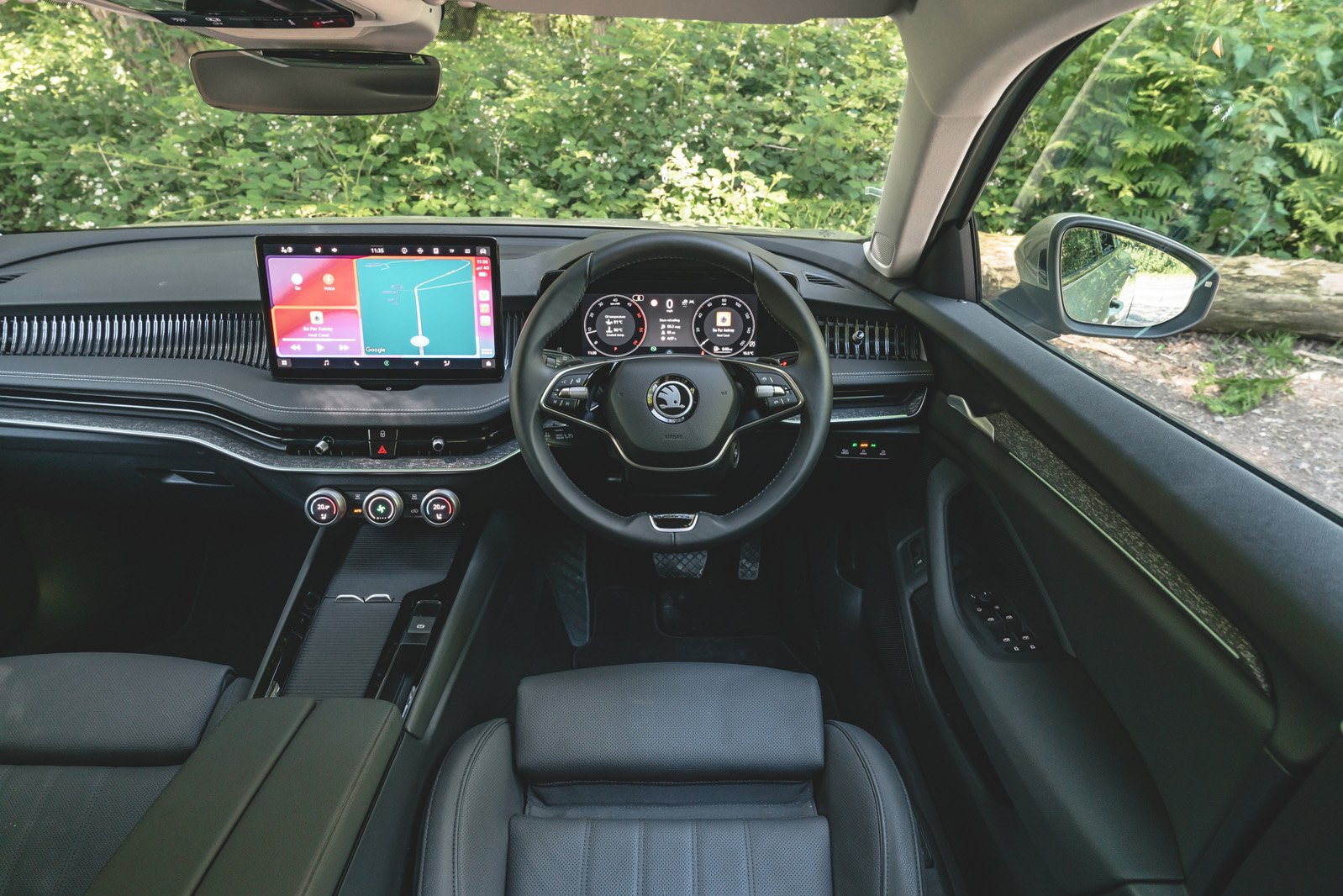
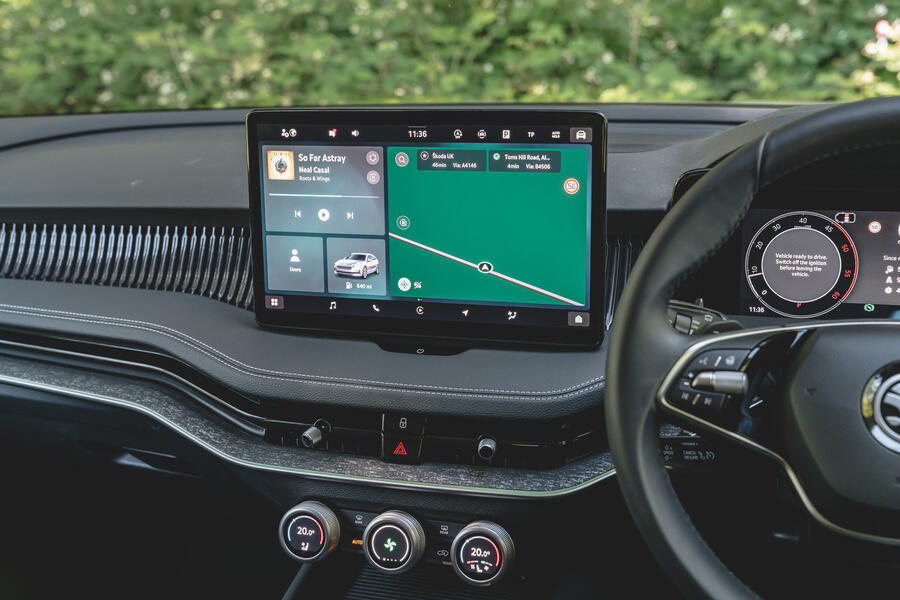
There’s a 13in multimedia screen whatever the trim level. While the overall button count is down, Skoda has shunned the minimalist iPad-on-a-plank route to infotainment integration in favour of a flowing design with wood-effect trim strips, elegant door handles and an almost art deco full-width vent.

Sportline variants, meanwhile, get racier accoutrements inside, including a sports steering wheel, Alcantara-like suede on the dashboard and door handles, and sports seats. It feels upmarket and yet still characteristically straighforward and robust, like a modern Skoda should.

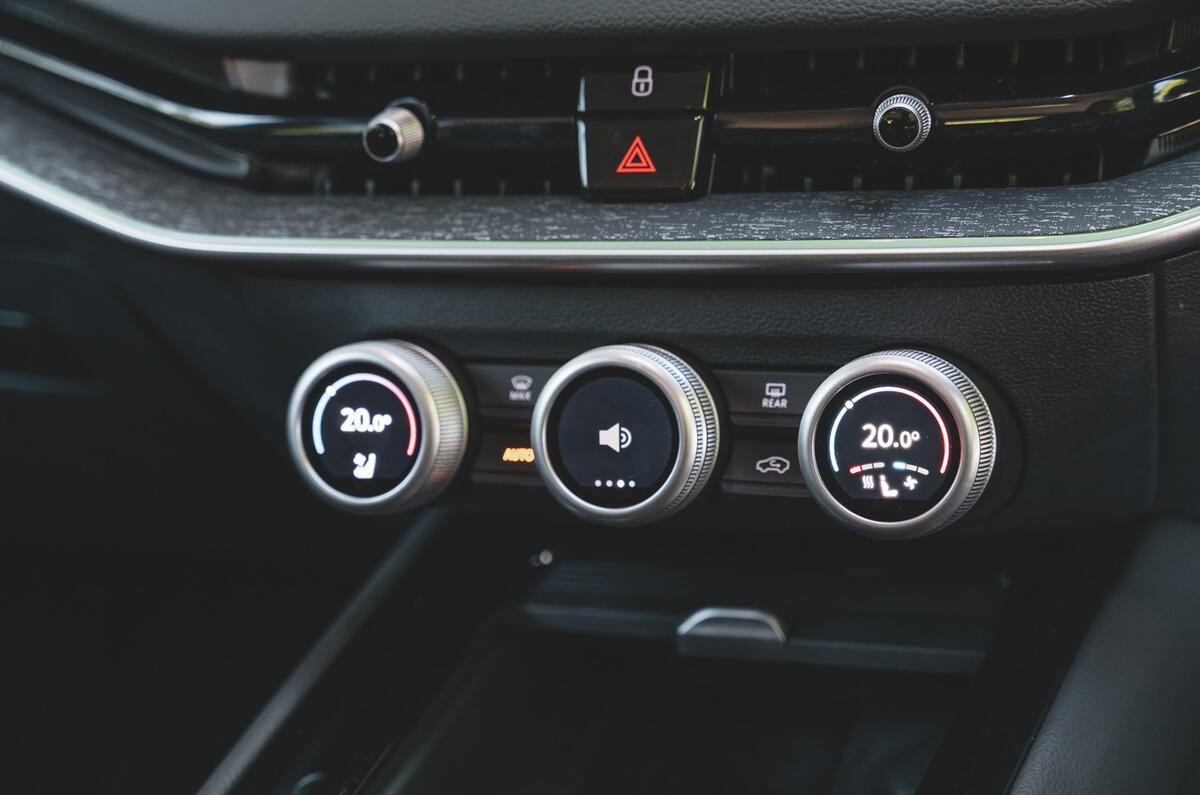
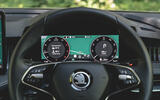
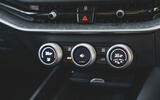
Quite a few functions are controlled through the touchscreen, but in its latest iteration, it works quickly and logically, and it is complemented by the Superb's new ‘smart dials’. The three physical dials can all be pressed to change their function, which is displayed on a small screen within each one. The outer ones control HVAC temperature and the heated and ventilated seats, while the central pod can control the fan speed, navigation zoom, drive mode, audio volume and more.

It’s a brilliantly simple yet tactile and intuitive system. If we have any criticism of the interior, it’s that the dials and the screen feel slightly flimsy and wobbly.

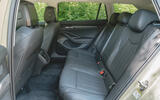
Rear passengers won’t feel like they are in second class, because the same materials quality is apparent here, and there are two USB ports, a climate control panel and, on SE L trim, an armrest with an integrated tablet holder.

Skoda hasn’t forgotten the basics, either. With the automatic gear selector having moved to the steering column, and no manual gearboxes, the centre console is freed up to provide storage. There’s plenty of space, naturally, and everything can be hidden from view by two shutters. The armrest cubby is big, too, and contains various movable trays and bins for things like glasses, and a useful felt-covered bar that you can use to clean smudgey fingerprints off the screen with (Kodiaqs come with one of these also).

Multimedia system

Skoda has always managed to put its own spin on the shared Volkswagen Group multimedia system – usually for the better - and that’s no different with the new Superb.

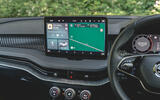
The 13in touchscreen is standard on all Superbs and runs the latest version, which in its base form is already miles better than what you'd find on the Octavia or the pre-facelift VW Golf. The home screen has customisable tiles that let you keep the navigation and the media on screen at all times. At the top of the screen is a bar of configurable shortcuts that gives you direct access to functions like the start/stop system and the auto hold.

The interface responds quickly, and Skoda’s smart dials complete the package, because they let you control the main climate controls without having to use the screen. Having a physical dial to zoom the navigation map is very useful too.

We found the standard sound system to be adequate, but there is room for improvement in the form of the optional Canton hi-fi.

ENGINES & PERFORMANCE

8
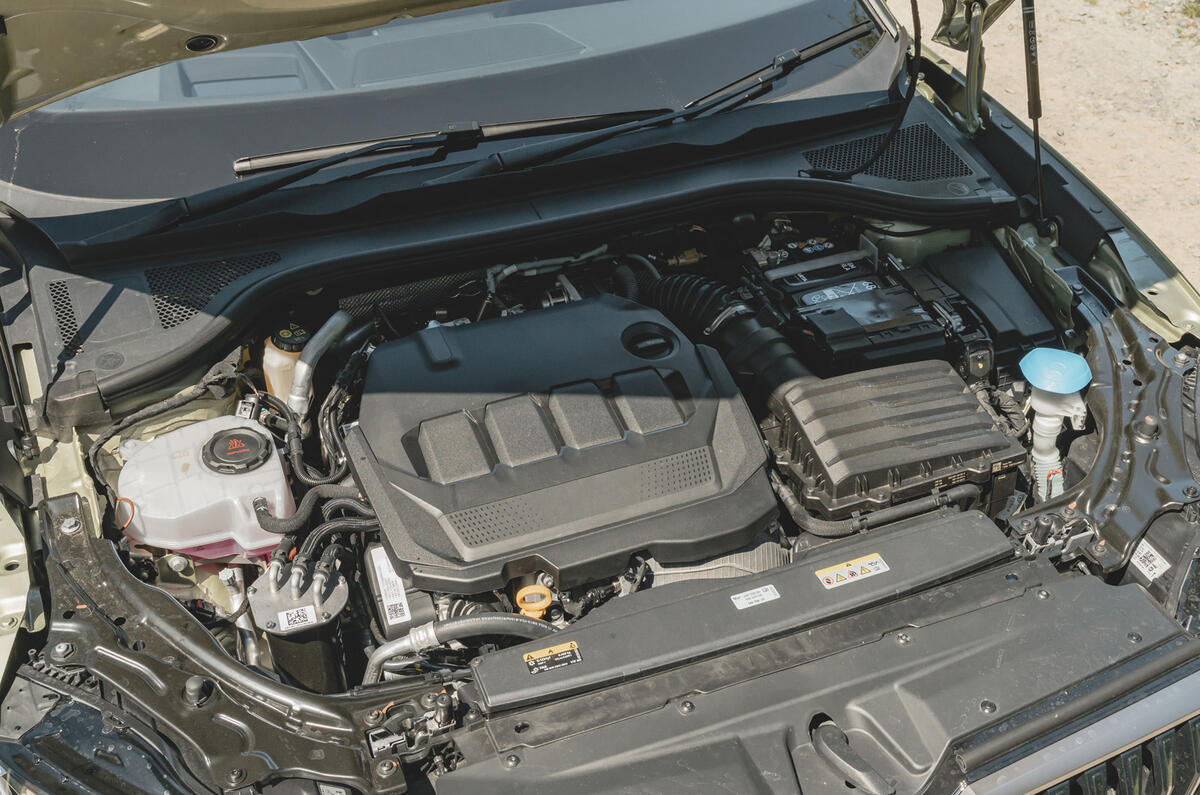
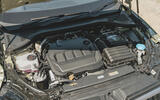
15 Skoda Superb 2024 engine

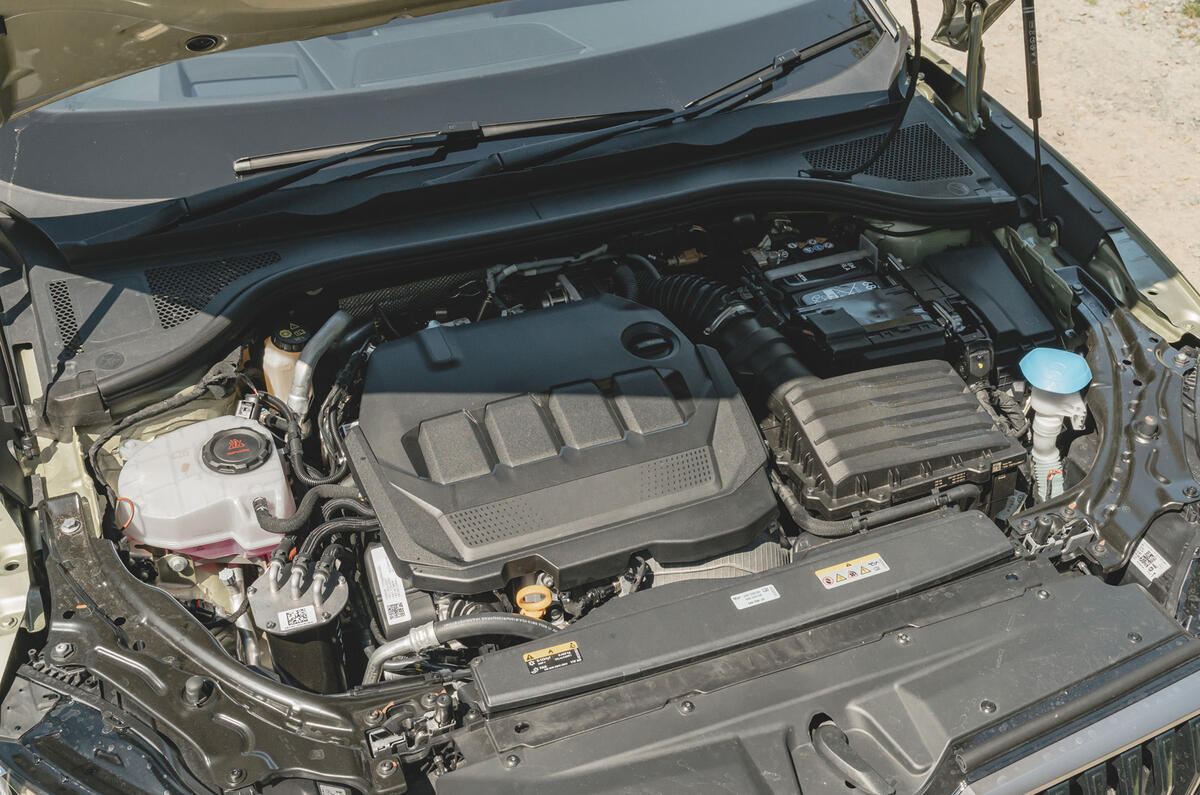
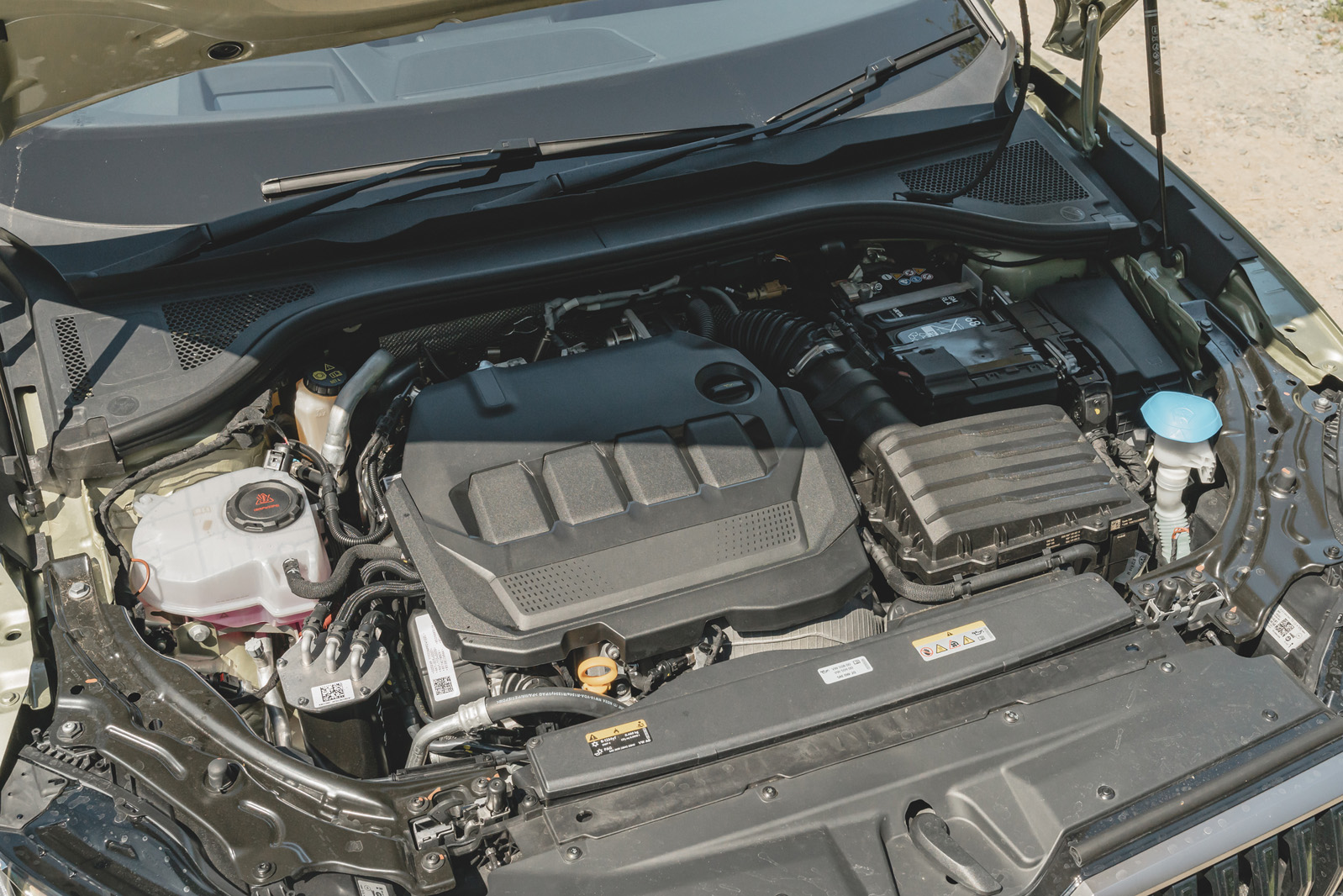
Skoda is persevering with diesel engines here, and reckons the 2.0 TDI 150 will be one of the big sellers after the PHEV and the 1.5-litre mild-hybrid petrol (a powertrain that we described extensively in our Volkswagen Tiguan road test). The lesser of two diesels is certainly quiet, hard-working, and has the potential for good fuel economy, although it can feel a bit short on torque in a big car.
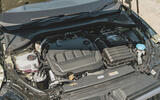
While the petrol is a respectable choice too and the market for diesel cars has shrunk significantly, it’s heartening that Skoda hasn't abandoned those drivers who cover big mileages or need a tow vehicle.

From cold, the four-cylinder TDI grumbles quite obstinately, and the dual-clutch gearbox can join in with some clunkiness and reluctance to downshift. However, once all the fluids are warm, the engine sounds quite smooth, with minimal vibrations, and the gearbox becomes more responsive.

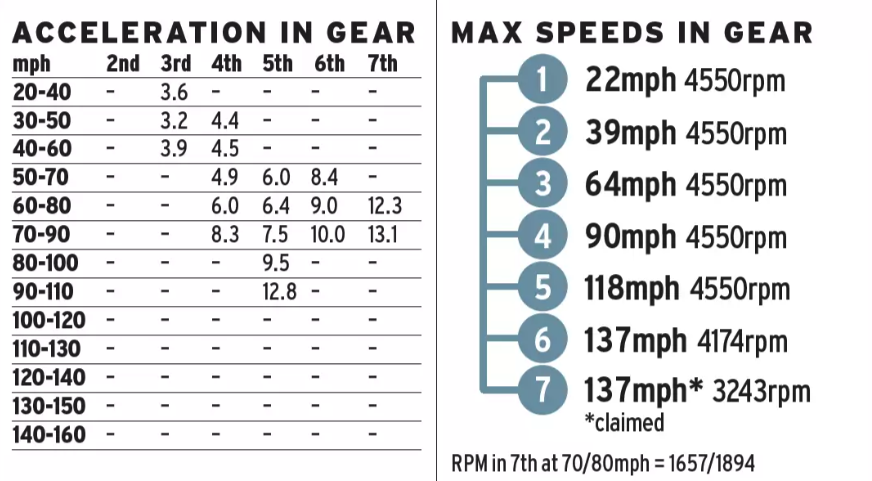
It retains some of the typical DSG tendency to upshift too early and to keep the revs too low, which can result in the engine bogging, then surging when you request some acceleration. A quick stab of the throttle usually prompts the gearbox to shift down a gear, though, letting you access the meaty mid-range you expect of a diesel (see in-gear acceleration figures for the 2.0 TDI 150 below).

Ultimately, the gearbox doesn’t have the fluidity of a good torque-converter automatic, but it’s good enough and rarely protests during hurried three-point turns.

We certainly have no complaints about the performance. We timed 8.9sec to 62mph and 23.7sec to 100mph, which are tidy numbers for any bread-and-butter combustion engine.

It’s quite hard to find a performance benchmark, since most of the Superb’s peers no longer come with a diesel, and premium options like the Mercedes E-Class tend to be more powerful. Naturally, the Superb is slower than the E220d, but it is on a par with the discontinued 2.0-litre diesel version of the Peugeot 508. It is easily grunty enough for everyday driving.

Braking performance is exemplary; our 2.0 TDI test car coming to a stop in 45.8m from 70mph in a controlled fashion during our test. With no regenerative braking to corrupt pedal feel, it’s nicely progressive.

Among the wider engine range sits the 201bhp Superb iV plug-in hybrid. This proffers plenty of accessible torque for a big family load-lugger, and has great easy drivability whether you're running in electric mode or hybrid. The car's 114bhp electric motor isn't particularly powerful, and has to move a car carrying a weight penalty of more than 250kg compared with a regular 1.5-litre TSI Superb; and so, while it has plenty of urge around town, it begins to feel a little short of it around the national speed limit; and you'll likely use the combustion engine plenty when accelerating at motorway speeds.

But neither thing would prevent this car from contributing plenty to cut your petrol budget down to size. Our test car delivered a dependable 50- to 55 miles of electric-only range during mixed real-world use; could be DC rapid charged, for greater zero-emissions usability when out and about; and returned around 45mpg in 'range-extended' hybrid running. It impressed with its mechanical isolation also.

At the other end of the Superb engine spectrum sits the 2.0 TSI 265 4x4, which borrows its turbocharged four-cylinder engine from the latest Volkswagen Golf GTI. It makes 261bhp and 295lb ft (the same power as it has in the GTI, but 22lb ft more torque) for a 0-62mph time of 5.7sec. That’s just 0.7sec adrift of a six-cylinder Mercedes E450d Estate, despite the Mercedes’ sizeable power and torque advantage.

The enduring Volkswagen Group ‘EA888’ unit remains smooth and quick here in this big barge. It’s responsive and energetic and gives the Superb an athletic character that belies its size and weight. Open the throttle and it surges forward with real pace. While it gets pretty vocal, it’s never overbearing or intrusive. Sure, there’s plenty of artificial noise piped into the cabin, but there’s a sporting timbre to it when you’re driving spiritedly. There's a bit of clunkiness from the gearbox at slower speeds, but it's fun to swap gears using the paddles behind the steering wheel. 

RIDE & HANDLING

9
2 Skoda Superb 2024 rear corner

The new Superb is neither overtly sporty nor exquisitely comfortable, but it lives in the crowd-pleasing middle ground that was always Volkswagen’s specialty. A 2.0-litre TDI on standard passive dampers has perhaps lost some of the suppleness of the outgoing car, but has gained a dash of driver appeal.

Body control is moderately tight on conventionally powered cars, both vertically and in terms of its resistance to body roll. Our diesel test car arrived on surprisingly sporting Goodyear Eagle F1 tyres, which gave it strong grip. In combination with steering intuitively geared, which gradually builds weight as you load up the suspension in a corner, this gives you plenty of confidence in the car’s roadholding. 

Over a few laps of the Millbrook Hill Route, the Superb remained composed even at higher speed, staying unaffected by the circuit's severe compressions. There is a slight tendency towards lift-off oversteer in faster bends when the chassis is provoked, but this is caught nicely by the stability control.

It's a similar story with the four-wheel-drive 2.0 TSI 265 Sportline model: there’s a bit of initial lean on turn-in, but the firmed-up dampers keep body movements under control and grip levels are high. Feedback from the steering – which is nicely weighty and feels intuitive despite its variable ratio – is good too. Dial things back and this Superb makes an excellent cruiser, albeit with a bit more road roar from its larger (19in) wheels.

The iV model feels a little softer and heavier than either of the other Superbs we've so far tested, and can begin to run shorter of vertical body control on country roads at bigger speeds; but, in typical motoring, is still measured and assured. It doesn't communicate its greater mass in the way it corners; this is a big car with relatively gentle chassis response however you configure it. It doesn't roll excessively or loll on its springs, but doesn't zap into corners either - rather behaving exactly as you might expect. 

The Superb does without four-wheel steering, so parking and guiding this large car around tight city streets requires a bit of circumspection; but is straightforward enough. The fact that Skoda has kept the car’s width under control, combined with an expansive glasshouse that hasn’t been compromised by styling flourishes, helps a great deal. The steering’s strong self-centring effect and the impeccably round wheel help in this respect too.

Comfort and isolation

The Superb’s ride isn't a little bit engine- and spec-sensitive, then. However, we are not minded to penalise it too hard for that. Sportline models fitted with the 2.0 TSI 265 engine get Dynamic Chassis Control Plus as standard (this powertrain is also available in luxurious Laurin & Klement trim) prove to be quite pliant-riding. Skoda claims that the adaptive dampers offer a broader range of damping characteristics thanks to the use of separate valves for rebound and compression; evidently, they're worth having even as an option on SE L models.

Their settings change depending on your selected drive mode, or you can pick your preferred level of firmness through Individual mode. In Comfort mode, the ride is pliant and composed, albeit with a bit of jostle at lower speeds on beaten-up roads. Swap to Sport and the car becomes more agile, hiding its 4.9m length well through corners.

That being said, the passive car is absolutely fine at speed, where the ride is tightly controlled yet not reactive or fidgety. But at town speeds, potholes can elicit a jarring wooden thunk, even though our car had relatively modest 18in wheels.

In SE L trim, our test car also came with the upgraded Ergo Seats, which have 14-way adjustability, heating and ventilation, and a massage function. They are terrifically comfortable over long distances: supportive but not overly firm, with enough adjustment to fit almost every body type.

Producing 69dBA at 70mph, the Superb is a touch noisy on the motorway. A BMW 5 Series or E-Class would be quieter, but that bit of added refinement is one of the things you pay handsomely for at the premium end of the segment.

MPG & RUNNING COSTS

9
skoda superb

Prices for the Superb start under £37,000 for the hatchback, and from a little over £38k for the estate. That buys you a 1.5-litre mild-hybrid petrol in SE Technology trim. And you needn’t spend more to get a well-appointed family car, since equipment such as heated seats with a massage function, adaptive cruise control, a wireless phone charger and front and rear parking sensors are fitted as standard.

But you might want to, of course; because SE L adds matrix LED headlights, electric memory seats, keyless entry, leather seats and the option of adaptive dampers. Load up a plug-in hybrid Laurin & Klement estate, and you will be paying over £53,000. Then again, that’s still quite reasonable compared with a Mercedes E-Class Estate.

Opt for the 261bhp 2.0-litre petrol model and you'll easily pay around £50,000, if not more, because it's available in Sportline and L&K trim only. 

Our entry-level, 148bhp 2.0 diesel’s real-world fuel economy was excellent. Over the course of our test, including the performance testing, it averaged 52.7mpg, and in regular use 60mpg was easily achievable.

Don't expect the same frugal economy from the 261bhp 2.0 TSI: around town we only ever saw around 21mpg, and an average of 33mpg on the motorway.

As regards the PHEV; how long's a piece of string, etc. Use that fairly extensive electric range plenty, charge regularly, and you could easily maintain better than 100mpg. Decline to charge at all and you'll be looking at 38- to 45mpg. 

Skoda offers petrol, diesel and plug-in hybrid powertrains, so there should be a Superb to suit every buyer, including high-mileage drivers and those who tow. The 148bhp diesel is rated to tow 2200kg.

Company car drivers should consider the PHEV, whose electric range has had a big upgrade for this generation. All versions are rated for at least 73 EV miles, landing them in the 6% benefit-in-kind tax band.

VERDICT

10
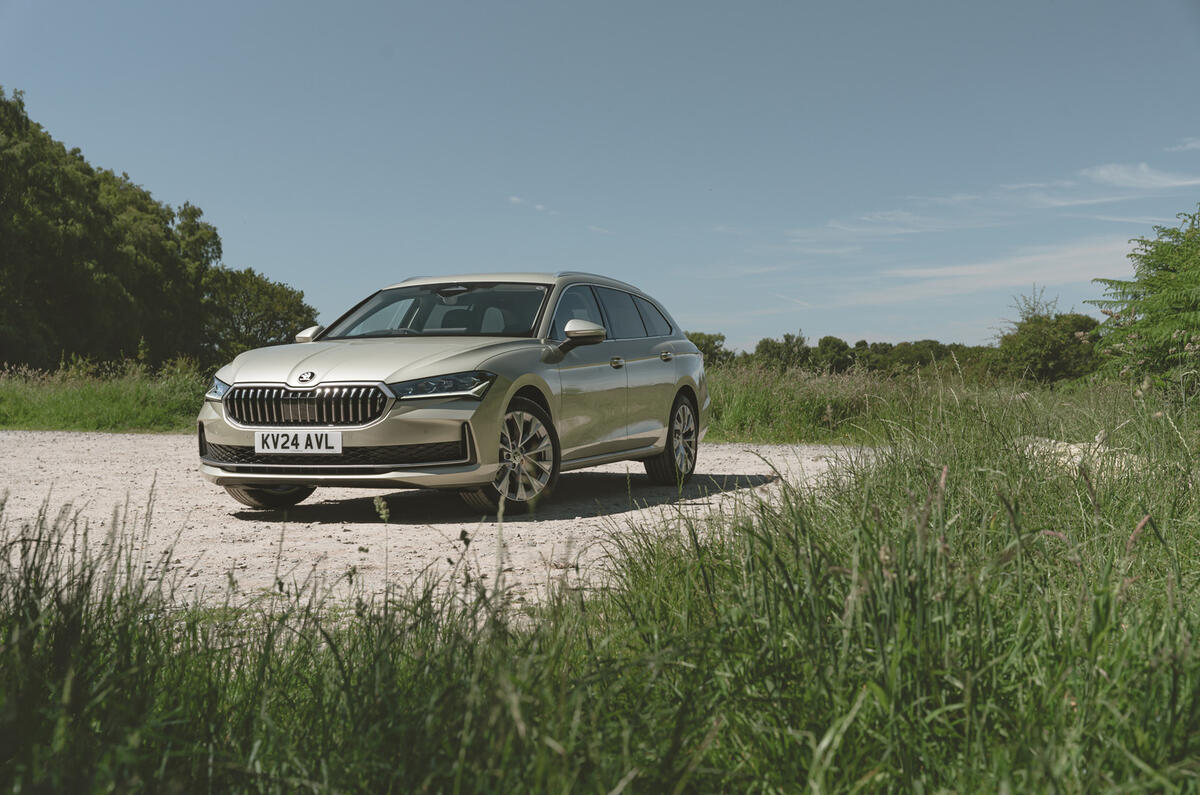
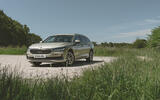
16 Skoda Superb 2024 static

Skoda has gained a reputation as the quiet overachiever of the Volkswagen Group. The Superb is the perfect example of how the brand takes mass-market VW mechanicals and software, and then makes them just that bit more usable and accessible by the application of careful design. A well-judged selection of physical controls, and a disdain for technology excesses and overstyling, stand the Superb in very fine stead.

While other manufacturers boil down their model ranges to just a few big sellers, Skoda continues to offer buyers a wide range of bodystyles and powertrains, including petrol, diesel and plug-in hybrid, which are all impressive in their own right.

With the fourth-generation Superb, Skoda hasn’t tried to reinvent the wheel. In the modern car industry, that kind of restraint seems almost an achievement in itself. By sticking to the essentials – space, efficiency, ease of use and intuitive driving characteristics – and doing those well, Skoda has produced a car that is outstandingly fit for purpose; makes the case for the estate car like few current rivals; and does so at a price that significantly undercuts its competition.

Sam Phillips

Sam Phillips
Title: Staff Writer

Sam joined the Autocar team in summer 2024 and has been a contributor since 2021. He is tasked with writing used reviews and first drives as well as updating top 10s and evergreen content on the Autocar website. 

He previously led sister-title Move Electric, which covers the entire spectrum of electric vehicles, from cars to boats – and even trucks. He is an expert in new car news, used cars, electric cars, microbility, classic cars and motorsport. 

Sam graduated from Nottingham Trent University in 2021 with a BA in Journalism. In his final year he produced an in-depth feature on the automotive industry’s transition to electric cars and interviewed a number of leading experts to assess our readiness for the impending ban on the sale of petrol and diesel cars.

Illya Verpraet

Illya Verpraet Road Tester Autocar
Title: Road Tester

As a road tester, Illya drives everything from superminis to supercars, and writes reviews and comparison tests, while also managing the magazine’s Drives section. Much of his time is spent wrangling the data logger and wielding the tape measure to gather the data for Autocar’s in-depth instrumented road tests.

He loves cars that are fun and usable on the road – whether piston-powered or electric – or just cars that are very fit for purpose. When not in test cars, he drives an R53-generation Mini Cooper S or a 1990 BMW 325i Touring.

Matt Saunders

Matt Saunders Autocar
Title: Road test editor

As Autocar’s chief car tester and reviewer, it’s Matt’s job to ensure the quality, objectivity, relevance and rigour of the entirety of Autocar’s reviews output, as well contributing a great many detailed road tests, group tests and drive reviews himself.

Matt has been an Autocar staffer since the autumn of 2003, and has been lucky enough to work alongside some of the magazine’s best-known writers and contributors over that time. He served as staff writer, features editor, assistant editor and digital editor, before joining the road test desk in 2011.

Since then he’s driven, measured, lap-timed, figured, and reported on cars as varied as the Bugatti Veyron, Rolls-Royce PhantomTesla RoadsterAriel Hipercar, Tata Nano, McLaren SennaRenault Twizy and Toyota Mirai. Among his wider personal highlights of the job have been covering Sebastien Loeb’s record-breaking run at Pikes Peak in 2013; doing 190mph on derestricted German autobahn in a Brabus Rocket; and driving McLaren’s legendary ‘XP5’ F1 prototype. His own car is a trusty Mazda CX-5.