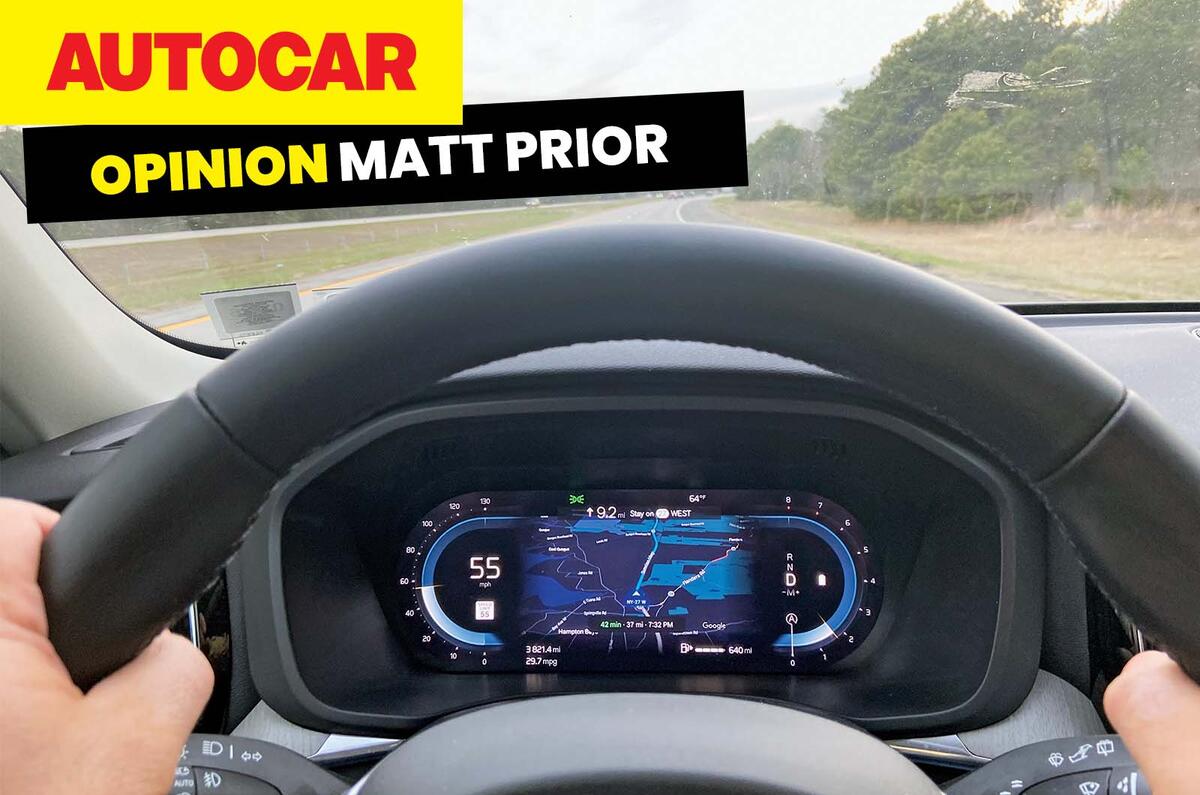
This week, the screen I will mostly be looking at is the one pictured below, after a hire car lottery ran out of Kia Picantos and provided me with a Volvo XC60. I’m not unhappy about this.
The XC60 is a comfortable car and this is mostly a comfortable screen to look at. It’s easy to be critical and plenty (including me) have been of the direction Volvo has taken with its interior functionality lately, with mass migration of controls to a touchscreen – including essentials like the foglight switches – at the expense of separate-button usability.
Speculation, of course, but this may be one of the reasons the pragmatic Håkan Samuelsson was restored as interim CEO. He’s a steady hand who understands that cars are not smartphones.
The XC60 has been around since 2017, and while its digital instrument cluster has been updated in that time, there’s still a lot to like about the simplicity of its graphics and fonts. It doesn’t overburden a driver with information;
I could turn off the map if I wanted. And I should also find myself pleased about the fact that it retains two dials, one for the speedo and one for the rev counter, because the genius of a dial is just how much it tells you in such short order.
At a glance, you can see a facet’s upper and lower limits, with a needle that shows how far along that range you are, the direction of travel and the rate of change. Numbers alone can’t do this: they can only tell you where you are right now.
There’s a reason that when film directors want to show an aeroplane in distress, they show a needle spinning anticlockwise very rapidly. We all know what it means.
That should make this Volvo’s dials preferable to use than the numerical script for the speed. Should but, I’m finding, doesn’t.
With dials nestling perhaps too discreetly around the edge of the screen and with a bold numerical font front and centre showing the speed right next to a graphic that apes roadside speed limit signs (usually but far from always, of course, getting the limit correct), I find myself looking at the numbers more frequently instead.
This is down to the size of the digits, but so glacial is the normal rate of change in daily driving anyway that going by the numbers isn’t too much of a drag.
And with a mildly hybridised engine, an automatic gearbox, busy traffic and New York state’s typical upper speed limit of 55mph, it’s not like I’m paying the slightest bit of attention to the rev counter either.
Were the rotary dial bigger and the supposed speed limit a small red telltale needle, I think the display would be more useful. As I find myself nearing a speed limit from above or below, it would be better to have a needle showing how quickly I’m closing in on it, but the instrument has been relegated to minor or cancelled status.
And this is the case all over the car business. Of the new cars I’ve tested recently, only in a Caterham Seven and a Morgan Supersport have I been overtly aware of a speedo needle spinning around a dial – and the Morgan had a supplementary digital numeric display too.
Even in Porsches and Ferraris, where you would expect the needle to move quickly, you find numbers for the speed, alongside, thankfully still, dials for the revs.
I think there’s an inevitability about this. Two large numerals take up less space than even a small dial, and it’s not like one can do away with a digital screen entirely, because modern legislation requires that the driver is presented with ample – often too much – information.
But is there a limit to how good a digital display can look? That in my XC60 is of high resolution, and even if the fonts do date, they will do so with Scandi-cool vibes.
It’s hard to imagine a display looking much more luxurious. I don’t remember the dials in the Rolls-Royce Spectre or Bentley Bentayga looking much better, and I’m not sure that should be the case.
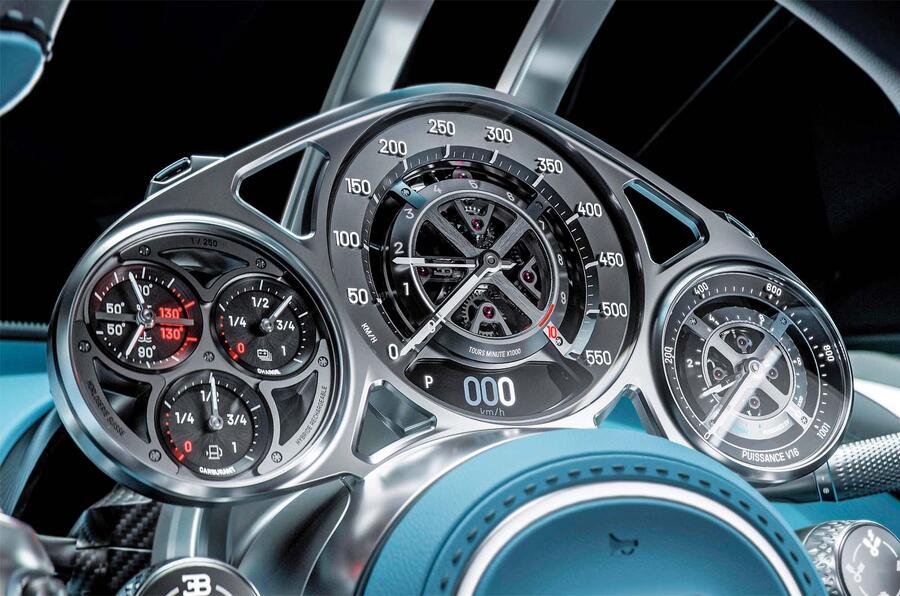
There is talk, then, that analogue dials – such as the speedo that features in the new Bugatti Tourbillon – will become a mark of luxury, in the way that, while the digital or smart watch has in most practical terms replaced the analogue one, the posh watches still have hands.
If it does, I’m for it, because well-presented dials aren’t just for show: they also tell you something that two digits can’t.

Join the debate
Add your comment
I have a digital display in my 4 year old Audi A5 Cabrio with 22,000 miles on the clock, which is great until it stops functioning. Audi dealer says the unit is not faulty and will replace it at a cost approx £3,500. They don't repair digital electronics ! Digital is great but at what cost. Warranty expired end November 2024 ! Such bad luck :( Come on Audi...FOC replacement surely. This cannot be the unit's natural lifespan
I've seen two instances of this problem with Audi digital dash,and both were fixed at a fraction of the new part replacement, one was an Audi TT which was taken to an electronics expert whose main business was fixing TV's, the central screen had gone wrong, it was fixed for $150.00 about £100.00 here,the other fixed here in the UK cost similar,so, if you don't mind looking I'm sure you could find someone to fix it, I saw these repairs done on Wheeler dealers the TV programs,im sure you could find them on YouTube.
I like the cameras for checking if I'm parked in the space correctly and the HUD too, the bongs and beeps not so much a bit nannying at times, the actual flatscreen is fine for me,and agree with with some others,a mix of Analogue and digital would be fine.
I only half agree as I've seen some excellent digital instruments, but they fail more often due to software or other electronic problems, and are no better. So the best option is to have both as they complement each other. The foolproof and reliable mechanical dials for key things eg speed and fuel are safety necessities. Day to day l love the look of retro mechanical dials but only actually use the electronic data for speed, tyre pressure and range.