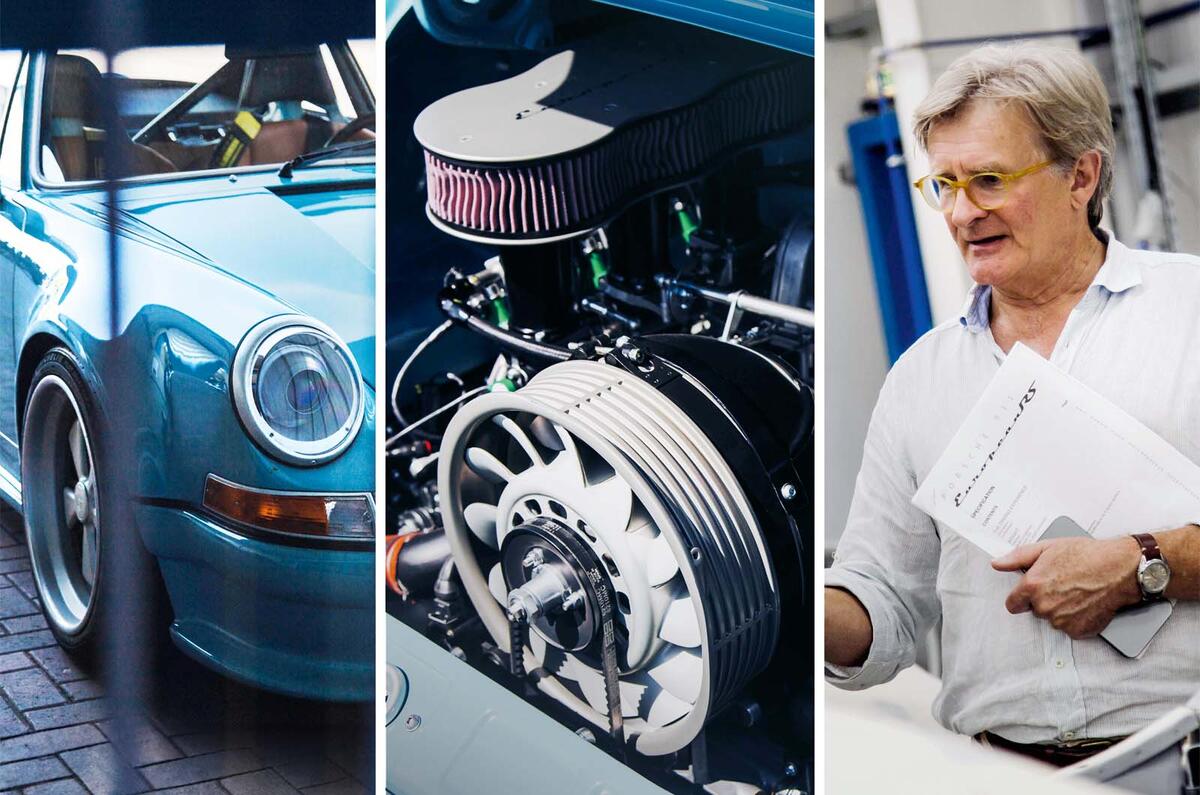

Restomod over-familiarity has led to a weary cynicism in many of us – but equally who among us, given the time and means, wouldn’t love to have a crack at creating our dream car?
To set out with no commercial imperative and draft a grand vision, then obsess over the details such that the end result fitted our wants and needs like a glove? It’s fantasy stuff.
What I hadn’t appreciated until recently was the kind of person you need to be to pull it off to convincing effect, even before you’ve pinned down a team of the calibre required for expert engineering and fabrication – the people who will slowly bring your vision to life.
Most of us would be better served keeping the dream confined to a beer mat and chasing after ready-to-wear options from Ariel or Ferrari.
It makes the 0.0001% of wonder-machines that do become a reality as world-class, from-the-ground-up commissions all the more tantalising. Projects like Thornley Kelham’s recent European RS.
“Hal could walk into the prep shop, look at his car from a distance of 10 feet and tell you the sill line is two millimetres out,” says Simon Thornley, co-founder of what is certainly an elite but under-the-radar British restoration company. “And he’d be right. That was the scary thing.”
Hal Walter is a retired Australian architect who spends half his time in the Alps. This partly explains why his commission took the form of a 911 restomod blending the spirit of a 1973 2.7-litre RS and the more recent 997-generation GT3 RS 4.0, which he also owns (of course he does).
It was an ambitious concept, but Walter is a man for details – every last one of them.
Shortly after Thornley Kelham agreed to take on the project, a near-40-page document arrived: the instruction manual.
When we visited the firm’s premises last year to see and drive the 95%-finished European RS, Thornley produced a printout and dropped it onto a table. It landed with a pronounced slap. “This is about the fourth version,” he said. “We’re now on version 23.”
The level of detail in this tome was exquisite, inspiring, just a little unnerving and perhaps understandable for a man with an architect’s mind and many, many hundreds of thousands of pounds on the line.
Part prescriptive (one can’t help but admire the inclusion of gear ratios), it took more of a manifesto form elsewhere.
The intake needs to wail like this, the chassis balance should feel like that and so on.
The car will weigh such and such in full running order (start with an original 911 T chassis, please, rather than a commonly used 964 one, as it will save us 300kg). There was also the design, both inside and out.