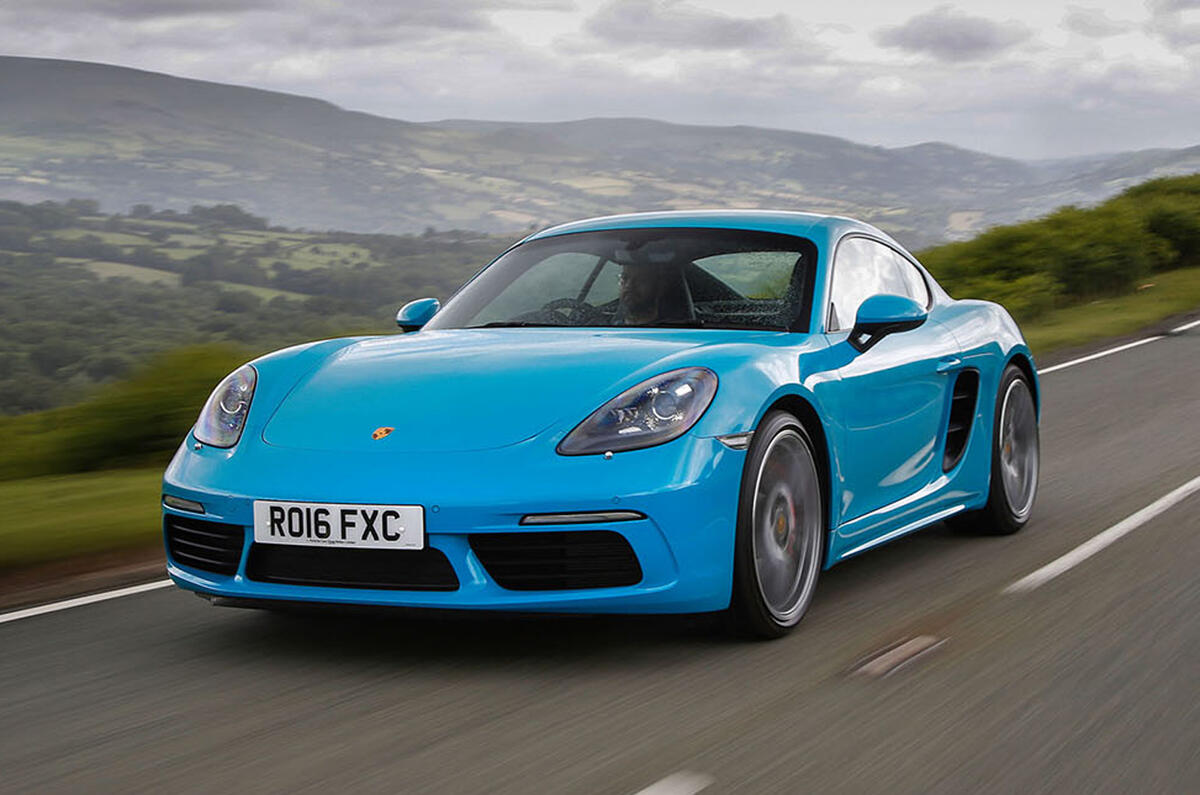

The Porsche 718 Cayman S has returned poorer real-world fuel economy than the V6-powered Jaguar F-Type in What Car? True MPG testing.
The findings of the True MPG testing showed that despite Porsche opting to downsize the Cayman S from a six-cylinder to a turbocharged four-cylinder for better efficiency, the model still consumed more fuel than a Jaguar F-Type V6 auto.
See all of the latest What Car?'s True MPG results here
Under True MPG testing, the 718 Cayman S returned 28.39mpg, versus an official figure of 34.9mpg, equating to a shortfall of 18.7%.
The F-Type performed marginally better in the True MPG tests, delivering 28.79mpg, a 14.3% difference over its claimed figure of 33.6mpg.
The Cayman S was one of a batch of 20 models tested under What Car’s new True MPG process. A Porsche spokesman said “the basis of any official Europe-wide Government legislated testing is the NEDC - an agreed industry standard that provides a repeatable consistent platform for cars of all types to be assessed and which intends that data is easily and accurately compared with other cars. The car industry is currently working with legislators on revising the NEDC.
“Of course, the real world will present variations based on road conditions and driving styles. It can be higher than the official standard fuel consumption, but also lower if the driver adopts an appropriate driving style.”
The Porsche spokesman also highlighted the greater efficiency, power and torque in the new Cayman versus its six-cylinder-powered predecessor, as well as the model’s low real-world NOx emissions, under independent analysis.
The top performer in the first batch of True MPG testing was the six-cylinder BMW M2. The BMW strayed from a claimed 33.2mpg by just 5.3%, achieving 31.43mpg.
Meanwhile, other models that underperformed include the Volvo S90 D4. It has an official combined claimed figure of 64.2mpg, but under True MPG testing it achieved only 39.9mpg; this is the largest shortfall of all 20 cars tested, at 37.8%.
Volvo issued the following statement in response to the results: “Volvo cars meet all current emissions standards and figures quoted come from the current European testing procedure.
"There are well-known differences between results from the official laboratory tests and those performed on the roads with results varying due to a number of reasons including driving style, traffic levels and environmental conditions.”
Volvo also stated that the introduction of Real Driving Emissions (RDE) testing from next year will address the differences highlighted by the True MPG testing.
The Audi A4 3.0 TDI 218 was the next worst performing car, with a 36.2% shortfall on its official fuel economy of 65.9mpg; it returned 42.0mpg. Audi responded to the result, saying: "All new Audi models are tested independently in accordance with the current official Europe-wide government legislated NEDC regime to which every automotive manufacturer must adhere.
"These figures are intended by the NEDC as a guide only and the ‘real-world’ results will, of course, differ depending on a number of factors. This is made clear in all our public-facing communications."