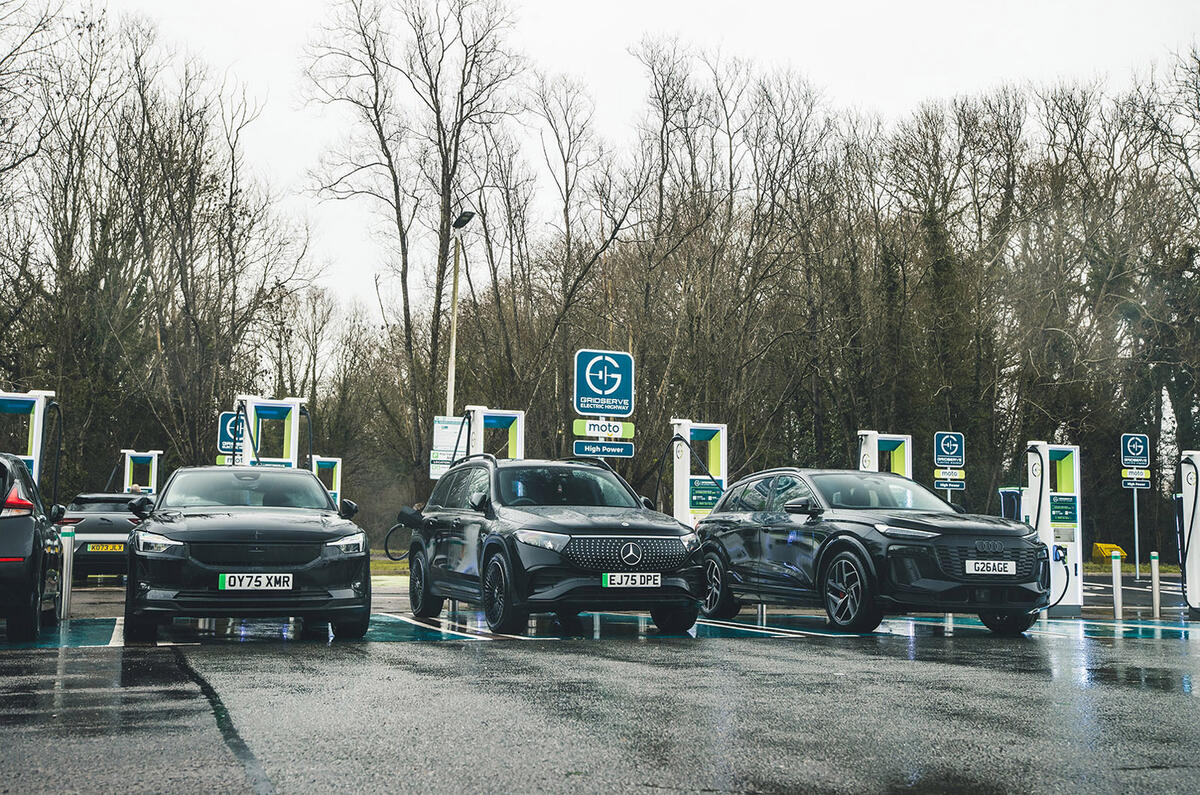



An increased reliance on expensive public chargers have pushed fleet EV charging costs to rise 15% since 2025, averaging 13p per mile, according to Rightcharge.
The company analysed “tens of thousands” of fleet charging sessions processed through its automated expense platform during the first half of the year, totalling 1.5 million kWh of electricity across home and public chargers – data that's usually used to help company car drivers recoup those costs from their employers.
This showed that fleets aren’t always making use of the cheapest available charging rates. The average cost of charging an electric car was 46.9p per kWh in the first half of this year, compared with 40.5p in 2025 – a 15% increase.
For a typical EV, travelling 3.5 miles per kWh of electricity, that’s an average cost of 13p per mile. Singling out fuel costs, a petrol car would break even at 49.5mpg (based on the Department for Transport’s average pump price of 145.9p per litre) over the same period.
The same EV could cost as little as 6p per kWh or 2p per mile (equivalent to 387mpg) if charged at home on a cheaper overnight energy tariff, but Rightcharge’s data shows that real-world costs are significantly higher.
Fleets spent 23.8p per kWh on home charging in the first half of the year – 7p per mile, or over three times more than the cheapest rates. At equivalent prices, a petrol car would need to average an unlikely 97.6mpg to break even.
Rightcharge attributed the rise to fleets' increased use of public charging networks, up from a 28% share of electricity in 2025 to 41% in the first half of the year.
Public chargers are on average 3.5 times more expensive (at 80.9p per kWh) than plugging in at home, producing per-mile costs in line with a petrol car at 28.7mpg.
Such is the discrepancy between home and public charging costs that the latter accounts for 41% of fleets’ electricity consumption but a massive 70% of their total charging bill. Rapid chargers can be priced at anything from 55p and 91.5p per kWh.
Depending on where drivers plug in, that’s a difference between £16.50 and £27.45 for a 30kWh charge – a 50% top-up something like a Hyundai Kona Electric or Volkswagen ID 3 Pro.
Home and public charging also produces very different usage patterns. The data shows 71.2% of home charging sessions take place outside business hours, suggesting drivers plug in overnight; rapid charging was the opposite, with 80.5% taking place during work time.
Freddie Winterbotham, Rightcharge's head of strategic partnerships, said the results show a need to understand where and when drivers plug in and educate them on the cheapest available networks.
He commented: "The savings from electrification are real, but they're the reward for managing charging well, not something that happens automatically. They slip away when nobody is watching the numbers. Win buy-in and the cheaper charging choice starts to look like the easier one."