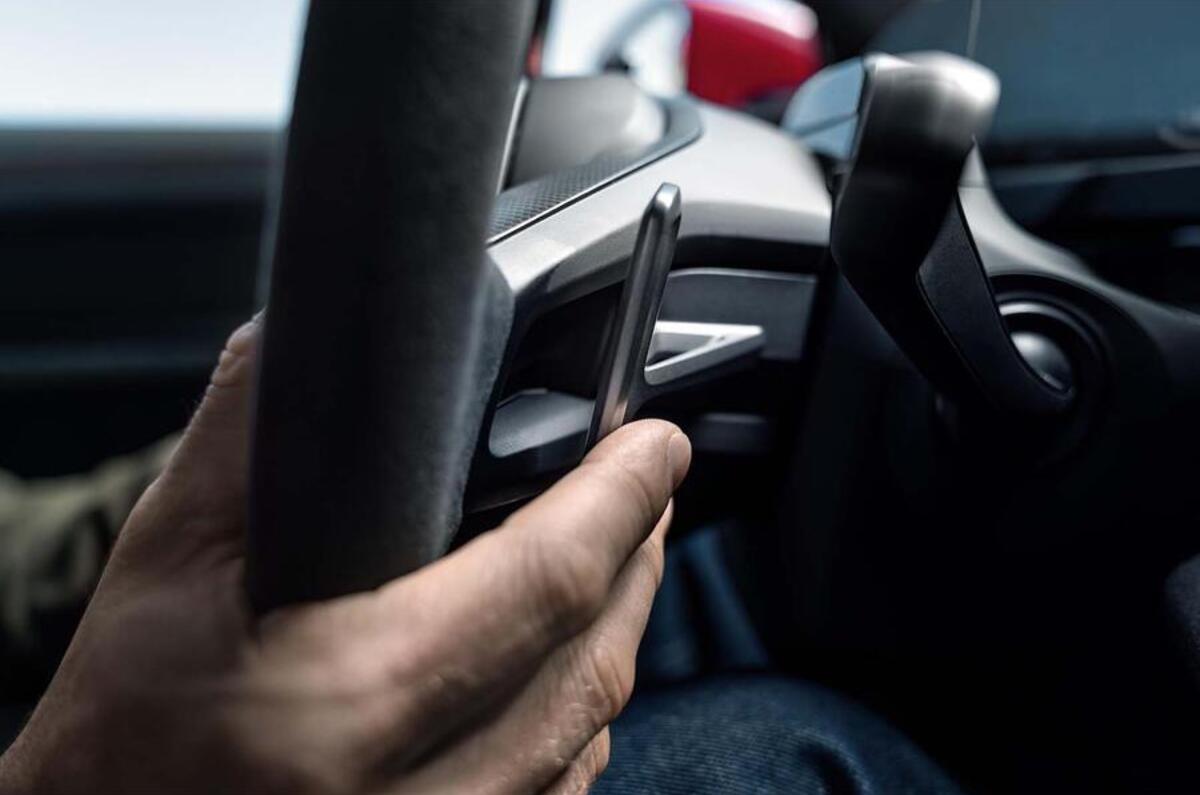


With the arrival of EV powertrains, we've seen some crossover from virtual gaming to reality, rather than the other way around.
It happened with the Ioniq 5 N's N e-Shift when Hyundai became the first to admit that for sports cars a howling high-performance combustion engine and mechanical gearbox were going to be a tough act to follow. Porsche designed its E-Shift system to spice up the Taycan, as BMW will with the M3 EV due in 2027.
Walk through the mists of time and the psychology of why these virtual stepped-shift systems are now a must-have becomes clear. Back in the day, there was a choice of manual gearboxes or unappealing torque-converter gearboxes known as slush 'boxes for the lack of positivity of their snail-pace shifts. Manuals were a talking point among drivers, whether the gate was precise or not, the engagement slick or clunky, the throw of the gearlever long or excitingly short. These details could make or break any chance of a perfect driving experience.
Then Ferrari introduced the semi-automatic gearbox in Formula 1 in the late 1980s and suddenly there was something else to hanker for in road cars. It appeared in 1997 with the F355 F1. Then Alfa Romeo launched its similar automated manual, the Selespeed. Before both of them, BMW introduced its SMG (Sequential Manual Gearbox) in 1996 on the 'E36' M3 and two more quicker-shifting versions followed.
They were essentially robotised, single-clutch, manual gearboxes that interrupted torque when shifting, with questionable degrees of satisfaction. Shift speed was limited by the need to retain synchromesh whereas a sequential racing gearbox could dispense with it to achieve millisecond-quick shifting with a 'dog' engagement gearbox at the expense of noise and an eye-wateringly high wear rate.
The prospect of matching that came with the dual-clutch gearbox. British firm Automotive Products conceived its Hot Shift gearbox concept in 1980 and Porsche's PDK appeared in motorsport in the mid-1980s. Dual-clutch gearboxes under various brand names-eg DSG and PDK-all do the same thing. Two clutches allow the next gear to be automatically pre-selected and a gearshift constitutes opening one clutch and closing the other without interrupting torque.
The holy grail of acceleration at last? Not quite. That came with the seamless stream of torque from an electric motor. Except we appear to have gone full circle because what once seemed so appealing may not be so involving in reality. Perhaps, after all, those brief interruptions of progress create a sense of anticipation and excitement a human brain just cannot live without.