
Noise, Vibration and Harshness (NVH) are three of the most important words in the engineering of new cars.
They describe exactly that: noise and vibration generated from hundreds of sources, from the texture and undulation of the road surface to the entire drivetrain, tyres, brakes and structure of the car itself.
Often it may not be activity from the source that the car's occupant notices directly but rather the result it has on another part of the car, such as a body panel that resonates, perhaps to some harmonic disturbance elsewhere.
Over the years, engineers have done everything in their power to overcome NVH—from simply stuffing cars with heavy sound deadening and underlay in the pre-computer era to the introduction of complex equipment for measuring vibration and sound and even riding in the boot to track down a squeak.
With the arrival of computer simulation in the past couple of decades, it's become possible to model the path of NVH from its source. But in addition to virtual tests, many real-world test drives are still needed to complete the job, as Porsche attests.
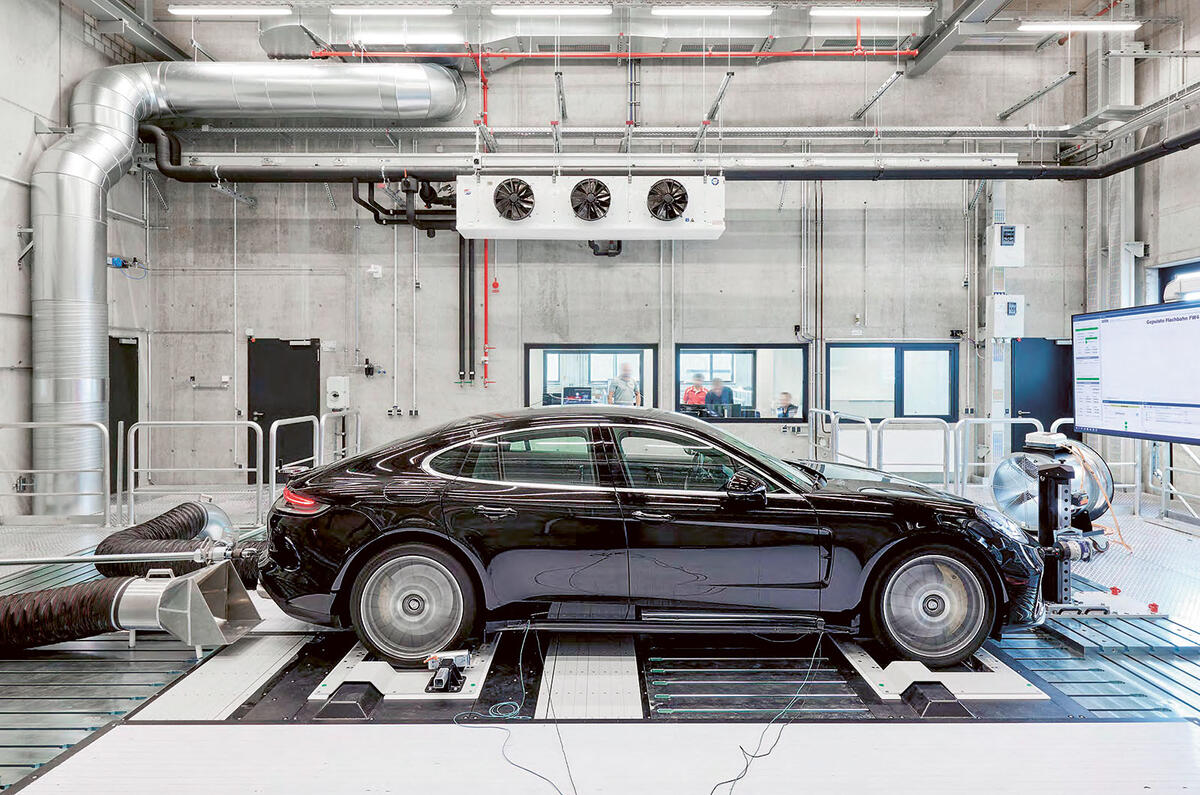
Last year, it began using a new road simulation test bench at its R&D base in Weissach, which goes by the name of 'FaSiP'. The bench can be used to control complete cars for vibration characteristics as well as individual parts like axles.
As for complete cars, they are flexibly mounted on the FaSiP, each wheel running on an individual, 0.4mm-thick steel belt. The belt speeds can be varied, causing forward and aft movements on the tyres and vibrating the car. Hydraulic rams below the belt can generate vertical impulses too.
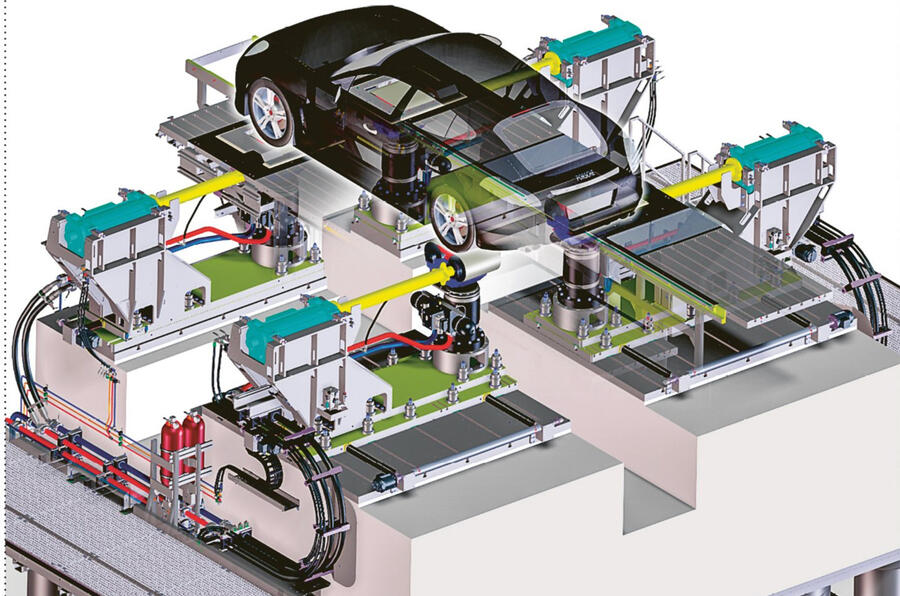
The combination can reproduce forces in the real world encountered by changes in road surfaces, manhole covers and suchlike. It's important to test these things with the wheels rolling because, for example, tyre stiffness is different when stationary.
Unlike testing on the road, which gleans an overall acoustic profile, the test bench can be set up to focus on individual aspects, a bit like putting an individual area of concern under a magnifying glass. Engineers can sit in the car during tests and modify or remove specific 'excitation' components and frequency ranges to pinpoint problems.
Porsche says FaSiP is so detailed in its capabilities that it's possible to reproduce any type of vibration that has occurred on the car anywhere in the world. The bench is claimed to be unique in that it can simulate road excitations at up to 155mph, vertical movements of plus or minus 4mm are achievable and excitations can be generated across a broad frequency range of 0-50Hz.