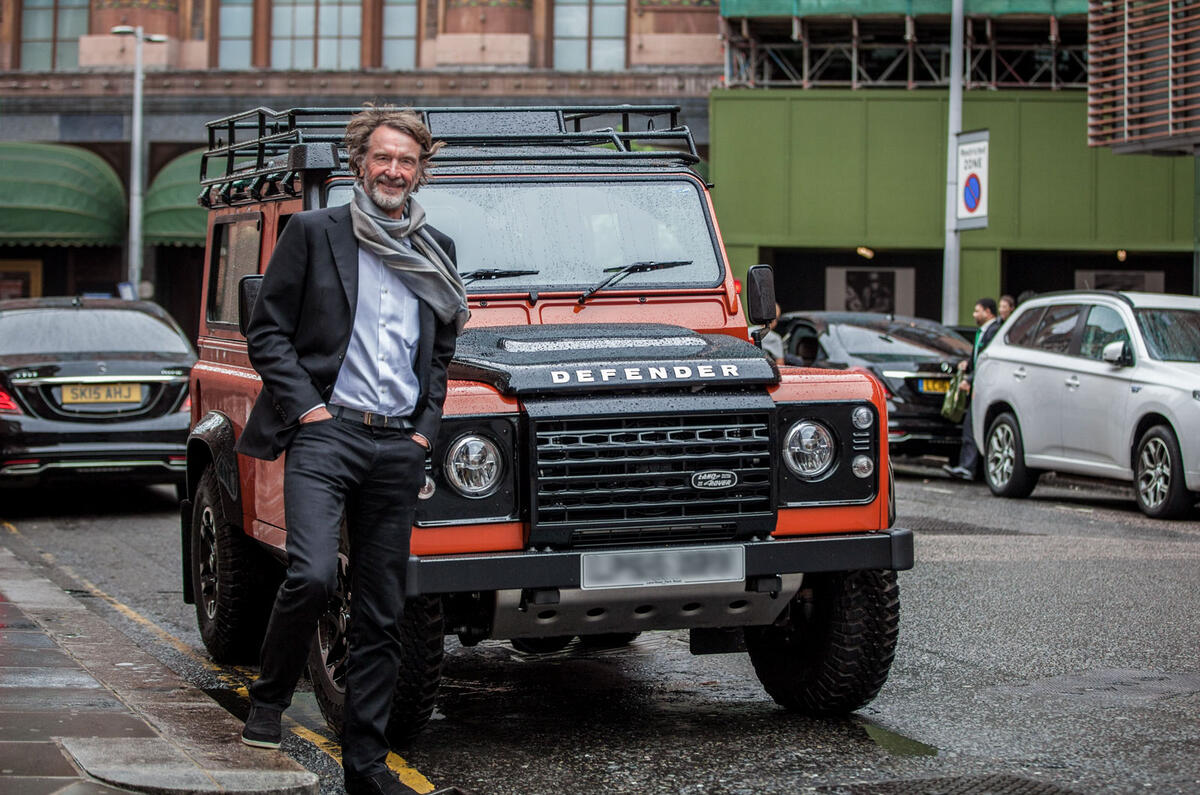

An Ineos built replica of the Land Rover Defender would most likely retain a diesel powertrain in order to be reliable and tough enough for customers in Sub-Saharan Africa.
The model, which would be be built and badged as an all-new car, but bear strong resemblance in both look and character to the Defender, is currently being considered for production by chemical giant Ineos.
The firm is due to carry out a feasibility study to see if the model is econonically viable for production this year, with the results due in December. If the results are positive, Ineos's director has told Autocar the model is likely to feature a powertrain and underpinnings borrowed from another automotive brand.
"Fundamentally we're not in the industry so we'd want to partner with an experienced brand," explained Tom Crotty. "We think there is an ongoing market for the vehicle if you can make it reliable and conform to [safety and emissions] regulations. We've done a lot of stuff in Africa and they love [the Defender] out there, but they don't love its reliability."
New Land Rover Defender due in 2019
Crotty suggested that sticking with a proven powertrain would be most appropriate, given that it would have to be reliable in extreme climates and conditions. "[An] electric [drivetrain] is too advanced - this car needs to work to work in Sub-Saharan desert," he added, before confirming that the old Defender's Ford Transit-derived diesel engine would definitely not be used.
Crotty cited the US and Africa as key markets to be considered for the new model, adding that the US was a largely untapped market for the original Defender. "It's the world's biggest buyer of SUVs and a market of more than 300 million people," he said.
Ineos wants to retain the character of the original Defender, but admits a new model would be "significantly upgraded" in order pass increasingly stringent safety and emissions tests.
"Some of the development would include ground-up design, and some of it would be smaller manufacturing detail changes," explained Crotty. "We’re used to managing enormously high reliability with our machines [in the chemical and energy industries]. The Toyota Land Cruiser will be a benchmark for reliability."
Will it make production?
Ineos first revealed its intention to build a reborn Defender to the press earlier this month. The company, headed by billionaire Jim Ratcliffe, revealed it had held talks with Jaguar Land Rover about the possibility of putting the Defender back into production, but the car maker has repeatedly dismissed the idea.
“There is no way this is happening,” a JLR spokesman said. “We’re not going to let anyone build our Defender.”
Despite JLR’s stance, Ratcliffe said in an official statement just days later that he was a great admirer of the Defender and is determined to bring it back in some form. “I think the Defender can be upgraded to be the world’s best and most rugged off-roader,” he said.
Ratcliffe added that there would be few copyright issues to overcome due to the Defender’s age.