This small EV is easy to live with, assuming you don't mind touchscreens

The EX30 is the smallest model in Volvo's current line-up, but apparently you can fit an elephant in it. 

Okay, it's a metaphorical elephant in the form of a 12.3in touchscreen mounted in the middle of the EX30's minimalist dashboard, but it's absolutely one we need to address.

That screen, or rather Volvo's decision to minimise the amount of switchgear by using it to control almost every function (heating, foglights, glovebox, you name it), has been the subject of plenty of criticism, including from us. 

When Matt Prior first sampled the EX30 in late 2023, he described it as "one of the least pleasing user interfaces on sale", reflected in his two-and-a-half-star rating. That verdict wasn't well received in Gothenburg, especially because it was at odds with the majority of reviews. 

Except, well, was it really? If you strip away that verdict and read the substance of our review, it was similar to most others: praising the EX30's design and dynamics (Prior termed it "a genuinely great car to drive") but taking issue with its user interface. 
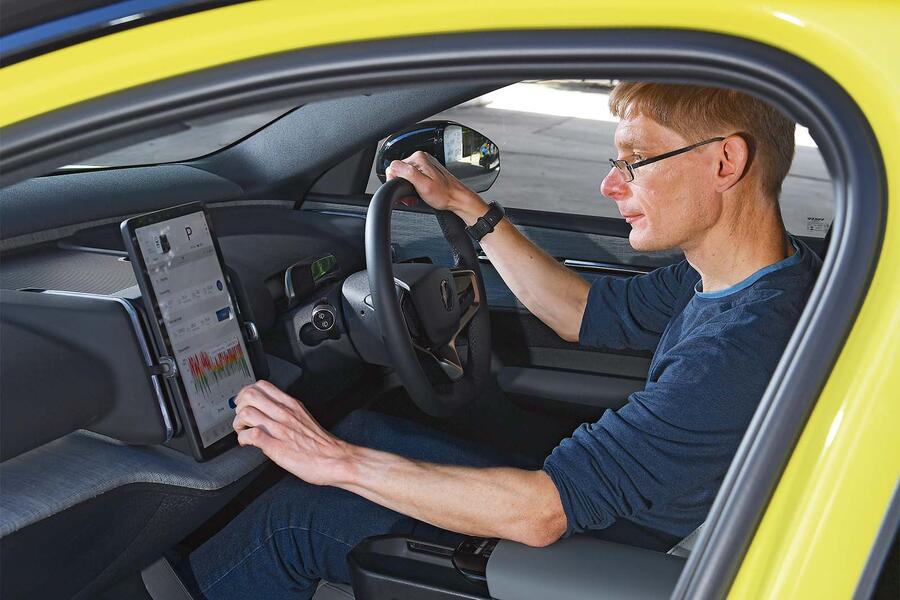
Updates to that UI were promised through over-the-air software updates; some reviewers seemingly made allowance for that, but we always rate as we find. Those UI-based criticisms held the EX30 back both in our road test and an affordable electric car group test-at the same time as it continued to win plaudits and group tests elsewhere. 

I can't speak for the approach of others, but for 130 years Autocar has assessed the whole package in every aspect, just as a buyer would. It doesn't matter if a car is stylish and nice to drive if you're driven to rage trying to operate it. 

Advertisement

Read our review

Car review

Volvo moves one market niche smaller to bring in younger, climate-conscious buyers

Back to top

That's a long way of saying our new EX30 has much to prove to us. And, we should say, credit to Volvo for agreeing to let us run one: not every car firm would in similar circumstances. 

Perhaps there's confidence that familiarity with the EX30 will warm us to its charms, and that subsequent software updates have improved that infotainment. Volvo does have some reason to be optimistic: it sold close to 100,000 EX30s globally last year, so there's clearly consumer demand. 

As always, we will approach this test with an open mind and enthusiasm. And, frankly, I really want to like the EX30, because it's a new, relatively small car and the world needs more of them.

At a time when premium brands have been pushing to bigger, more expensive products-such as the massive and pricey Volvo EX90 – here's a new model with premium sheen yet is sensibly sized and built to be offered at reasonable cost. 

I like the story of the EX30: to keep costs in check and reduce the CO2 emitted in producing one, Volvo made all sorts of clever design decisions. Putting the window controls in the central storage unit halves the amount of wiring needed, while the big Bang & Olufsen soundbar cuts the number of separate speakers needed.

And, yes, putting most of the controls on a touchscreen cuts the number of physical buttons and dials needed. 

Back to top

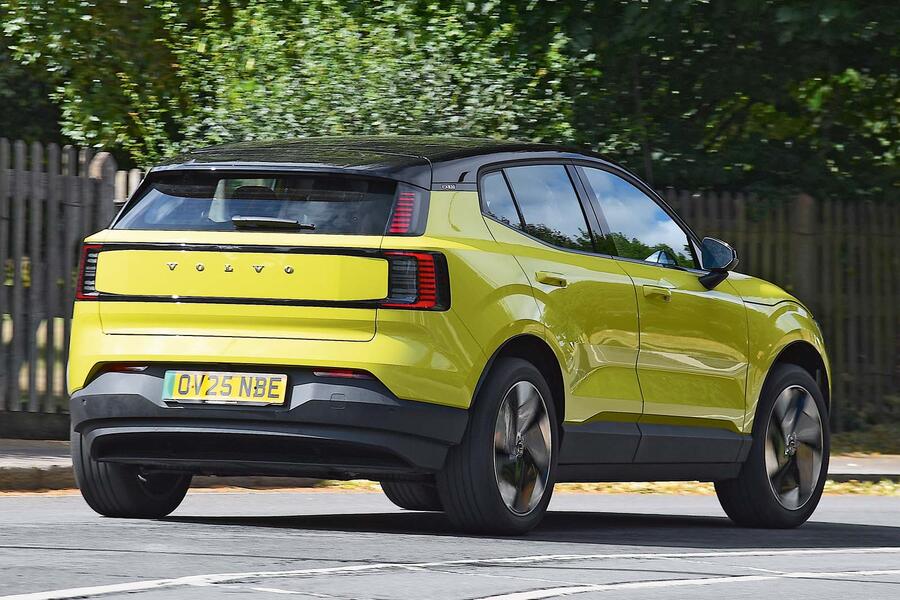
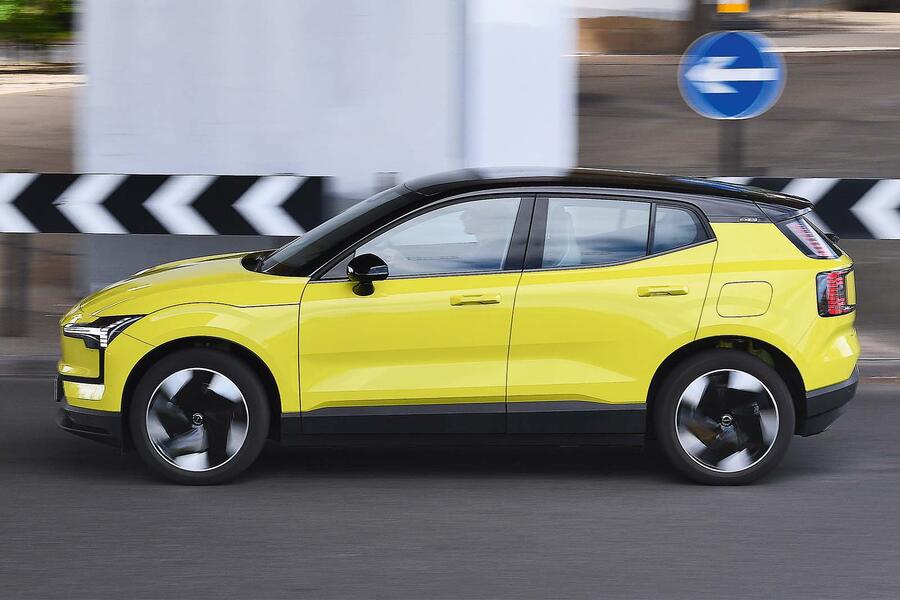
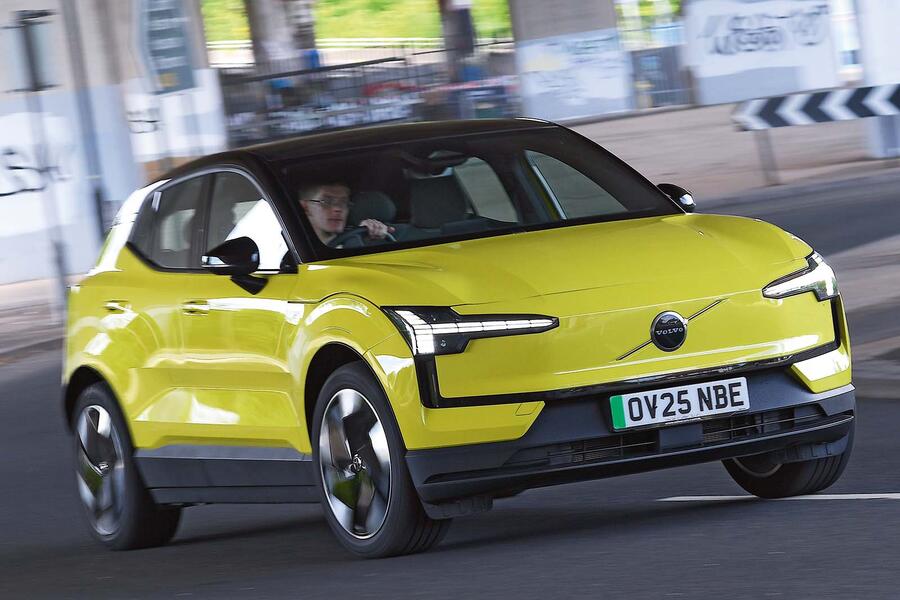
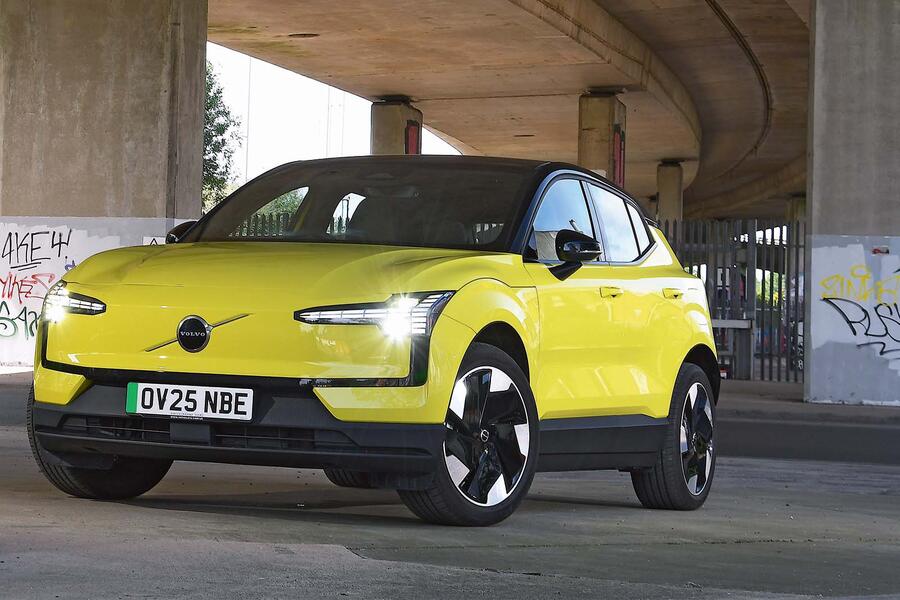
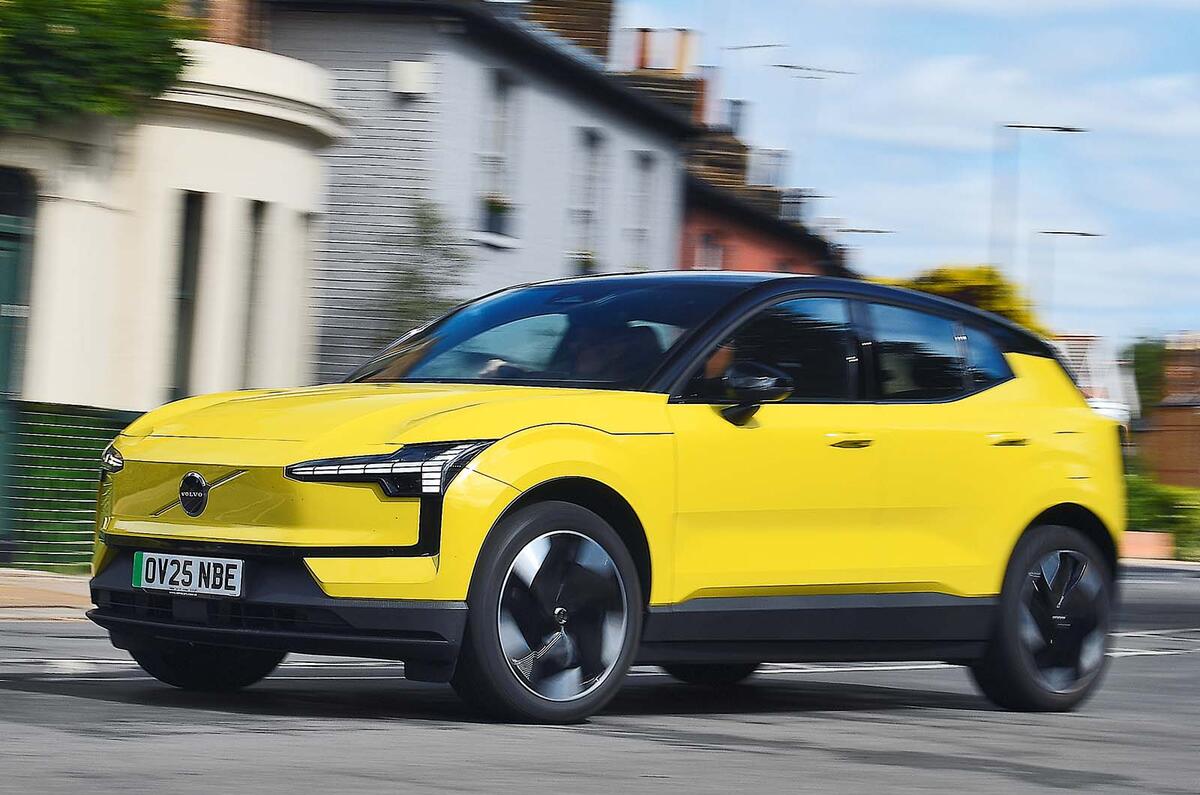
It's a nice piece of design, too: recognisably Volvo yet still fresh. There are neat details, such as the Volvo lettering in the tail-lights, the "Thor's hammer" headlights and a fresh take on the firm's grille slash. 

Also, our EX30 is in the best spec: it's a Single Motor Extended Range model, which gives an official range of 296 miles from a 65kWh (usable) battery, while still offering 268bhp and a 0-62mph time of just 5.3sec.

Steve Cropley tested a Single Motor model with the smaller battery and it proved the best EX30 we had driven so far. More range should make this even better. 

Speccing an EX30 is simple: there are three powertrains (Single Motor, Single Motor Extended Range and Twin Motor Performance) and three trims: Core, Plus and Ultra. We have gone for mid-level Plus, which offers niceties such as adaptive cruise control, a flexible boot system and various sensors. 

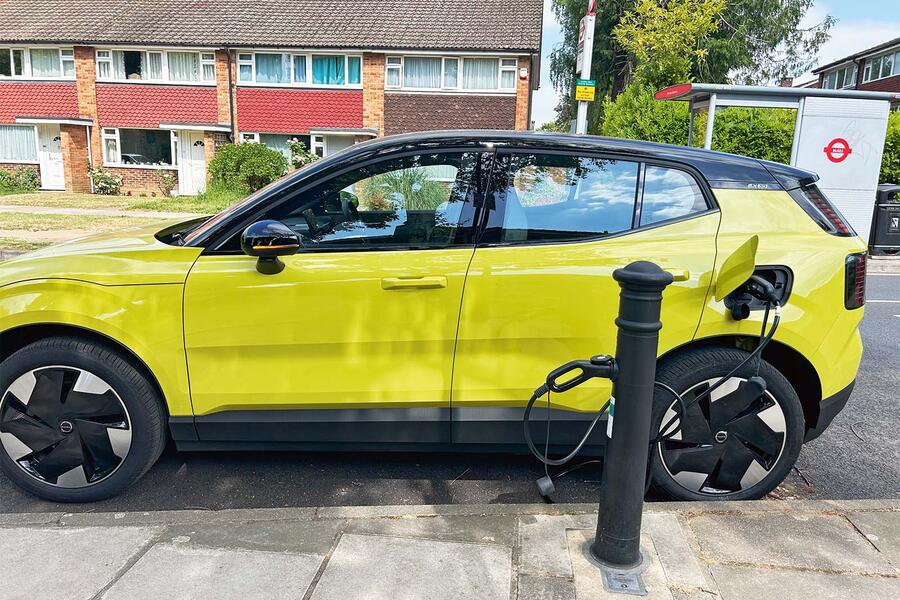
Total price: £39,850. We added as much relaxing Scandi-cool as we could with the Wool Blend and pine-style Nordico upholstery, giving the interior the calming feel of a Swedish forest, and selected Moss Yellow paint, apparently inspired by coastal Scandinavian lichen. It certainly makes the EX30 stand out, even if it's nowhere near as vibrant as our new yellow Renault 5. 

Back to top

And so far it's proving really nice to drive. The ride can occasionally jostle a little on bumps, but that's true of many smaller cars. But the powertrain is smooth, the steering is light and direct and it's comfy and spacious inside. In short, it's as good on the road as we first reported. 

And that screen? Well... the driver monitoring is annoying, the bongs are a bit tedious and I'm still occasionally having to search a bit too hard for key controls, but I'm loving having Google Maps as the native sat-nav system. 

We will deal with that proverbial elephant more in the coming months. For now, we're keeping an open mind and hoping the charms of the EX30 can outweigh some of the frustrations we've previously expressed. It's going to be a fascinating car to live with.

Update 2

So far, the Volvo EX30 is proving to be an enigma. In certain respects, it's brilliant, yet every time I settle back behind the wheel and think about declaring my love for it, something really annoying will happen. 

And that something will usually be accompanied by an even more annoying beep. As you may recall from when Volvo's small crossover joined our fleet, it has much to prove, given our previous experiences with the touchscreen-dominated interface. 

But before we get distracted by that, I am impressed by how pleasant the EX30 is to drive. Colleagues have had reservations about the powerful twin-motor versions we've tried, but in this format - with a single rear motor and the biggest battery - it's a pleasing cruiser. The steering is light and direct, and the car has a pep that belies the weight of its chunky battery. 

Back to top

And the suspension soaks up bumps and road imperfections amazingly well: several passengers have remarked on how comfortable it is to be driven in. The interior is very pleasant too, even if you can sometimes sense the cost restraints (more on that in a future report). 

Having all the controls on the touchscreen mostly works better than expected. That's greatly helped by the Google-based operating system, which is so user-friendly I'm not bothering to connect to Apple CarPlay. 

Having Google Maps as my native nav - and with the benefit of an estimated charge level on arrival at destinations I tap in - is brilliant, as is having a voice control that can mostly actually understand me. If you sense there's a but coming, you're right. Although it's actually a bong. 

Because the mandatory safety features can be really annoying. My chief gripe is the driver attention monitor, which is sometimes set off because I'm looking in my mirrors or glancing over to the top of the touchscreen to see what speed I'm doing-both of which, I would argue, very much count as paying attention. 

Meanwhile, any facial grimace vaguely similar to a yawn will set off the tiredness alert. Activating one of those alerts triggers an annoying bong, along with a warning that appears in the narrow driver info strip atop the touchscreen. 

Except the font is roughly 4pt size, making it exceptionally difficult to read without paying less attention to the road. Weirdly, if you set off the driver's attention monitor while indicating to turn (and you may well do so by looking out the side window to see if the road you're turning onto is clear), the indicator noise stops so that the bong can be heard. 

Back to top

Which often leads me to panic and think I'm not indicating. Now, these systems are mandatory and yes, they can be turned off - and very few car firms have really nailed them. 

But I have encountered better implementation in cars from other manufacturers, which, given Volvo's reputation for safety, feels a bit odd. If any firm should have the expertise to nail the implementation of driver safety systems, it's surely Volvo. 

I hope over-the-air updates will improve these systems. Because even a small improvement would enable me to spend more time focusing on the many, many things that the EX30 does really well. 

Update 3

As email subject lines go, "I'm concerned about your driving" certainly grabbed my attention. Given I try to be fairly careful and considerate at the wheel, I can't recall having been told that since one of my early driving lessons.

The sender was reader and keen EX30 owner David Williams, who decided to write about the EX30's driver monitoring alerts. I've found the monitor to be somewhat over-attentive, occasionally setting off when I'm looking in the mirrors or telling me I'm tired because it mistook a grimace for a yawn.

But David said that he and his wife had covered more than 18,000 miles in their EX30 "and never had that issue". In fact, he even found a safe environment to try to replicate my example of setting the sensors off by looking out of the window but never triggered the warning.

He suggested that perhaps I had been driving at speed and looking out of the window for several seconds, "which is rather concerning".

Well, fret not, David: I assure you I don't do that, and I'm going to try to adjust my seating position a bit to see what improves. Generally, though, David's feedback was much like that of other EX30 owners who have been in touch, in that he loves it. "We think it's a brilliant car and wouldn't swap it for anything," he wrote.

Andy Poulton is another satisfied owner (well, I say owner, but he's on Volvo's subscription scheme), and he called his Twin Motor Ultra Performance model the "best car I have had in 58 years of motoring". Mind you, his first EX30 suffered from a number of software issues, which were largely resolved after his garage instructed him how to do a hard reset.

Back to top

His second one has so far been issue-free, perhaps showing how Volvo has kept working on its software.

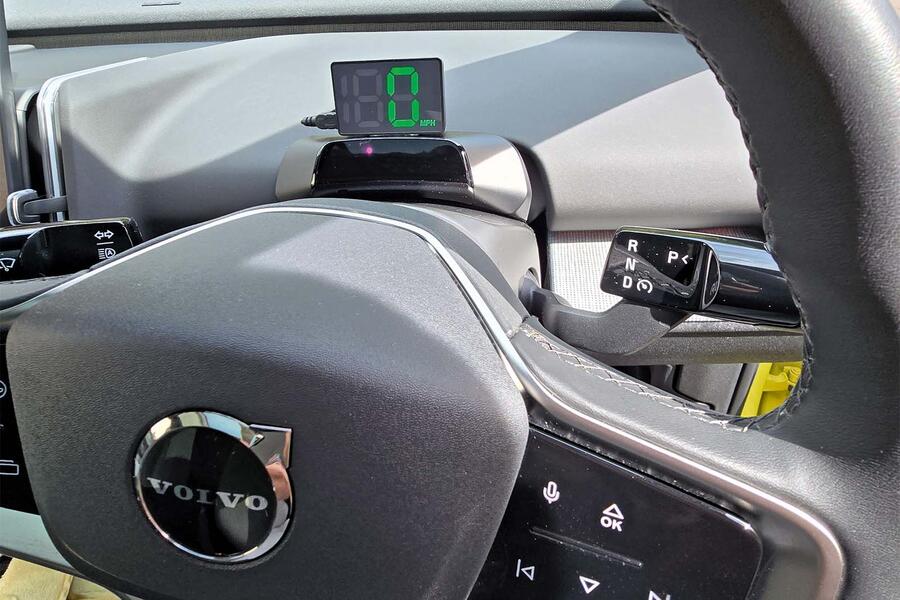
Still, there was one annoyance a software update couldn't fix: the lack of a driver display behind the wheel showing his speed. But he found a simple fix, buying a USB-powered, GPS-based speedo from AliExpress for £3.99 and balancing it on top of the driver monitor.

Over-the-air software updates are great, but sometimes the best solutions just require a touch of home-brewed practicality.

Update 4

"I wish I'd chosen an EX30 now," said my friend Soph, owner of an EX40. "It just felt a bit out-there without the instrument display, but I think next time I might go for it". Such was our chat when I told her that colleague James Attwood had leant me his long-termer.

I was excited to give the EX30 a try, given there have been a lot of things said about it, positive and otherwise. I like its looks and I enjoyed driving it too. No, it's not the most dynamic car out there, but broadly it's hard to fault given how effortless it is to rub along with.

The finer details are what stood out to me. First, when putting my son's child seat in the rear, I liked how the back seat had been designed so that you pull a neat flap of fabric out to find the Isofix anchors, rather than removing fiddly bits of plastic, which then need to be stored somewhere.

Back to top

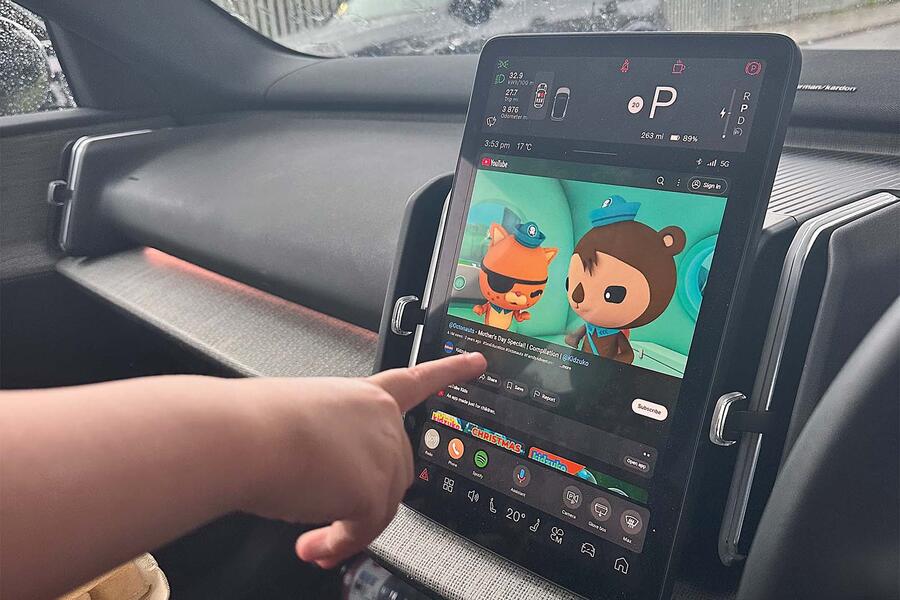
The little storage trays at the side of the rear seats are an ideal place to store a Peppa Pig and some Octonauts toy figures (if you have an under-five, you'll know what I'm talking about) and overall proved a great hit with my son. Not as much of a hit, though, as the availability of YouTube on the touchscreen.

I showed it to him for the novelty factor when we were parked up and briefly stuck in the car due to a torrential downpour and quickly regretted it. And with that scary dexterity of a toddler on a touchscreen, the next time we were parked up and with friends, he swiftly put YouTube on himself.

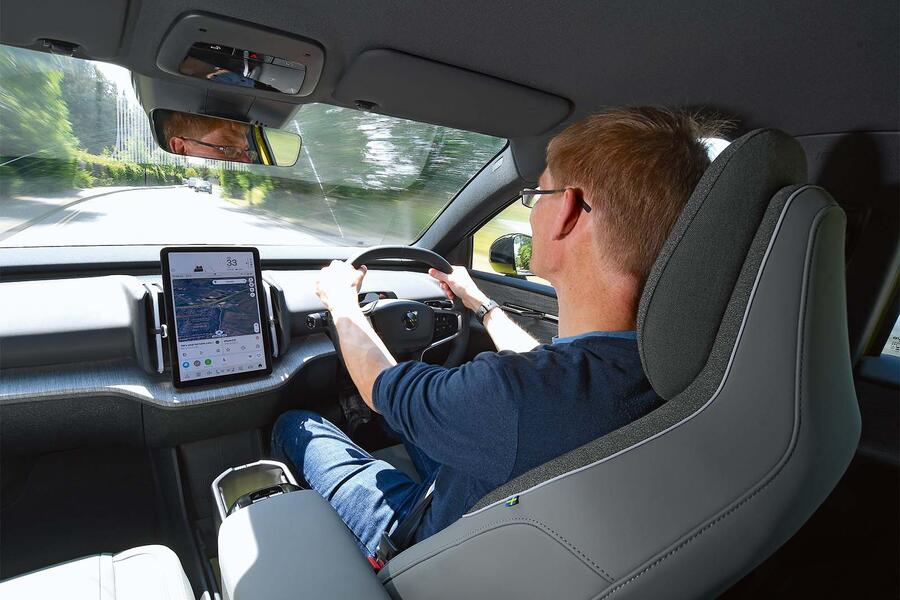
For my part, I found changing the position of the side mirrors via touchscreen menus tedious, as I regularly move them for parallel parking purposes. I also found having to avert my eyes to the middle of the dashboard to check the time or my speed a distraction.

The key without buttons was hit and miss. I always put my son in the car first on the nearside, and the number of times the EX30 failed to unlock was annoying.

Each to their own, but I'm not certain those irritations would ultimately be enough to put me off this car - and if the likes of Soph are open to adapting to these evolving tech trends for their next cars, Volvo won't be doing too badly at all.

By Rachel Burgess

Back to top

Update 5

The ever-shortening days and the arrival of colder weather often present a challenge for EVs, and sometimes in unexpected ways. Inspired by Tesla, the Volvo EX30 is now one of many EVs that have forgone a traditional instrument display and instead stuck key information such as your speed on the top edge of the central screen.

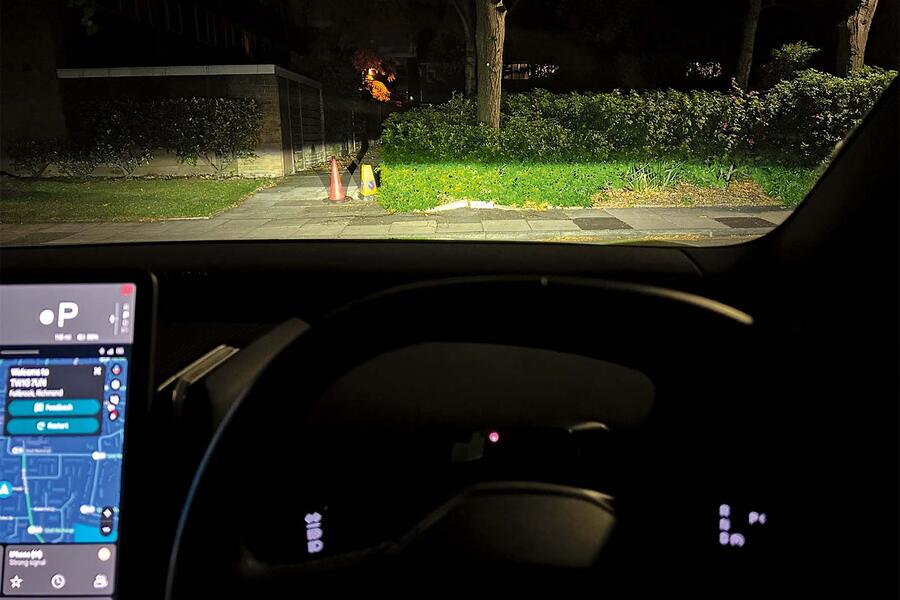
It's not a layout I'm a particular fan of but is one I've grown accustomed to and can live with. But it caused an unusual wrinkle when I first did an extended drive in the EX30 in the dark: I found the total lack of illumination behind the steering wheel really quite off-putting.

The top of the steering wheel simply faded into the darkness, the only light source behind it being a small red light showing the presence of the driver attention monitor.

I initially found it quite difficult to keep tabs on the wheel when turning, and the darkness meant it was hard to know at a quick glance how much steering lock I had on. I eventually adjusted to it, but again it doesn't feel that natural.

Volvo says part of the reason the EX30 does without an instrument display is to reduce the number of components and elements, reducing the environmental impact of its manufacture - which, not coincidentally, also makes it cheaper to produce.

Given that Volvo is now regarded as a premium brand, it's quite a challenge to do that without making the EX30 feel a bit cheap inside, but the firm has largely succeeded.

Back to top

The interior door material does feel a little flimsy and the thunk when you shut the doors is a touch on the tinny side, while the Nordico synthetic-leather upholstery looks the part but doesn't have the true luxury feel that premium buyers would expect.

For the most part, though, the reductive design works really well. For example, there's a single Bang & Olufsen soundbar in place of an array of speakers, yet the audio sounds fantastic to me. And I'm quite enjoying the retro charm of having seats that are largely adjusted manually.

The approach works well, because Volvo has done such a convincing job making the EX30 look and feel premium that you can excuse many of the areas where the cost-saving shows. Most of the time.

Because there are occasions, like when you're driving at night and your dashboard is dark save for the unblinking light of a driver attention monitor, when you're reminded of some of the bits the EX30 is missing.

Final report

We're in a transition era, witnessing the most dramatic shift in automotive technology since the car was invented. There's the switch from combustion to battery power, of course, but another kind of seismic change is also ongoing: digitisation.

Cars are increasingly being developed around computer chips and software, and that will make for a profound change in how we use cars in the future.

Most drivers will initially notice that shift through how they interact with their car, with the increasing reliance on touchscreens and digital controls instead of physical buttons. As with the transition to electric propulsion, things are a bit messy right now.

Car makers are trying to find an ideal balance between touchscreens and physical buttons, and people are often reluctant to change. Plenty of drivers like touchscreens; plenty hate them. That brings us to the Volvo EX30 I've been running for the past few months.

This compact SUV isn't the first car to put virtually every important control on a touchscreen (thank Tesla for that), but it is one of the first mass-market cars from a long-established mainstream manufacturer to do so and how well you can adapt to its controls will frame your view of it.

Back to top

When Autocar first drove the EX30, Matt Prior was hugely frustrated by its touchscreen, and the way that certain key controls were accessed was also criticised in our subsequent road test. Clearly not everyone shares those frustrations, because the EX30 has been a huge hit for Volvo, and the UK is the biggest market for the car.

Having had one for a while now, I can absolutely see why. Generally speaking, the EX30 is a right-sized, plush-feeling premium EV that's laced with Scandi-cool design and remarkably pleasant to live with.

Our EX30 was in the ideal spec: Single Motor Extended Range, with a rear-mounted motor producing a sensible 272bhp and a large battery to maximise real-world range. For a smidge under £40,000, it's a pretty compelling package, and one well suited to everyday life.

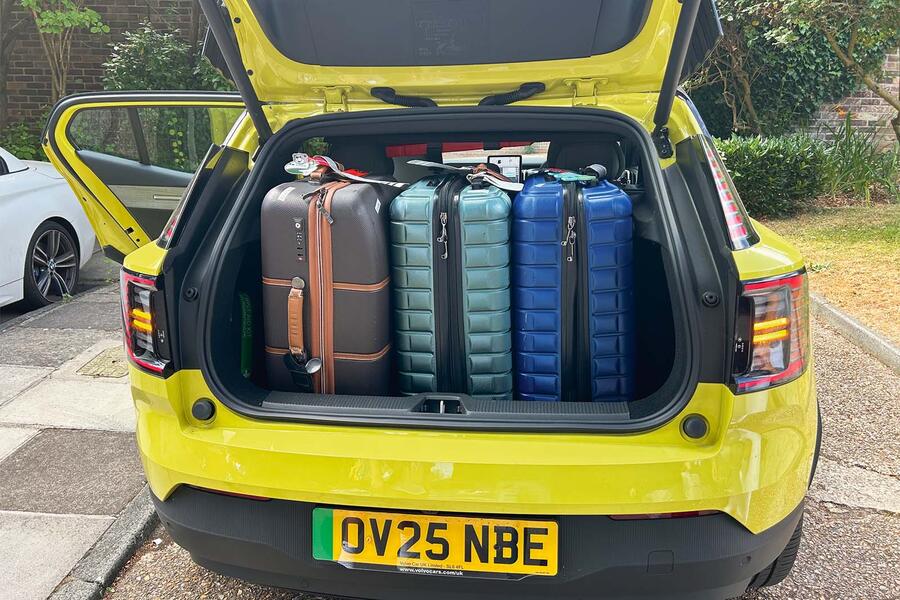
Its relatively small size made it easy to drive, and the steering was light, positive and responsive. The interior was plenty comfortable enough, the boot was a decent size and three people could fit in the back with relatively little complaint.

It was full of clever features too: for example, Rachel Burgess borrowed it for a weekend and liked how the Isofix points were covered by cloth, rather than fiddly bits of plastic.

The ride could get a little flustered and unsettled if I really attacked country roads, but for navigating cities or cruising on a motorway, it was refined and jolt-free. And although I could generate some wheelspin if I accelerated hard, the powertrain was generally smooth.

Back to top

The advertised 296-mile official range proved closer to 200 miles in reality, and I struggled to achieve the efficiency that some rivals now manage, particularly as the weather turned colder.

Averaging 3.2mpkWh would have been impressive a year or two back; now it lags a bit. Still, the EX30 makes a strong case for a small premium electric crossover, with many strengths as an everyday family all-rounder.

If you sense a 'but' coming here, you're right-sort of. Because, as already mentioned, your feelings towards this car will depend on how well you adjust to the touchscreen. I've grown accustomed to it over time, and my feelings about the EX30 have become more positive as a result.

Two chunky software updates helped: both brought useful new features to the car (albeit in some cases features that arguably should have been present at launch), in particular adding some key functions (such as the new Range driving mode) to the touchscreen's home page.

The software was generally good: the Google-based infotainment system meant Google Maps sat-nav was built in, and while I would have liked more customisation options, it was well laid out.

As with Teslas, I wasn't a fan of having the speed limit atop the touchscreen in place of an instrument display, but I adjusted over time. And while it's not the same as instinctively knowing where a physical button is, you do gain muscle memory: I learned where I needed to tap quickly to turn off the intrusive ADAS features or to access the heating system.

Back to top

I was less accepting of having to adjust the wing mirrors by delving through several menus of the touchscreen menu, then moving them using buttons on the steering wheel: the haptic-style buttons just weren't precise enough for the task. Also, many passengers struggled to adjust the audio volume, because they didn't know where to find it.

Such annoyances grated more because of how otherwise amiable the EX30 was-and because they wouldn't have been issues if a few more buttons had been present. However, the feedback I had from EX30-owning readers was almost universally favourable, with several recounting how they had overcome initial touchscreen scepticism and firmly loved the car.

Given how sad I was to see my EX30 depart, I can understand that. The EX30 won't necessarily be for everyone right now, then, but that's okay. You can still get an EX40 if you want a slightly more traditional electric Volvo crossover.

But if you can come to terms with the touchscreen's dominance, this is a very pleasing car to live with.

Volvo EX30 Single Motor Extended Range Plus

Prices: List price new £39,850 List price now £39,860 Price as tested £39,850

Options: Moss Yellow paint £0, Pine interior £0

Back to top

Economy and range: Claimed range 296 miles Real-world range 208 miles Battery 69.0/65.0kWh (total/usable) Test average 3.2mpkWh Test best 3.6mpkWh Test worst 2.7mpkWh Max charging rate 153kW

Tech highlights: 0-62mph 5.3sec Top speed 112mph Engine Permanent magnet synchronous motor Max power 272bhp Max torque 253lb ft Gearbox 1-spd reduction gear, RWD Kerb weight 1775kg

Service and running costs: Contract hire rate £385 pcm CO2 0g/km Service/Other costs None Fuel costs £448 Running costs including fuel £446 Cost per mile 8 pence Faults None

James Attwood

James Attwood, digital editor
Title: Associate editor

James is Autocar’s associate editor, and has more than 20 years of experience of working in automotive and motorsport journalism. He has been in his current role since September 2024, and helps lead Autocar's features and new sections, while regularly interviewing some of the biggest names in the industry. Oh, and he once helped make Volkswagen currywurst. Really.

Before first joining Autocar in 2017, James spent more than a decade in motorsport journalist, working on Autosport, autosport.com, F1 Racing and Motorsport News, covering everything from club rallying to top-level international events. He also spent 18 months running Move Electric, Haymarket's e-mobility title, where he developed knowledge of the e-bike and e-scooter markets. 

Join the debate

Comments
2
Add a comment…
Thekrankis 6 February 2026

Cars like this are a nightmare on fleets where different users borrow the car daily. My company Tesla constantly gets fiddled with and each time I drive it home I find settings altered.

Adter almost ten years of Tesla ownership I now HATE touchscreens. 

xxxx 6 February 2026

To say we're putting the window control button down on top of the central storage area to save wiring is pure gaslighting, my dad had a Cavalier with the same layout and it's a dire location, as bad a decision as removing all the buttons. knobs etc.